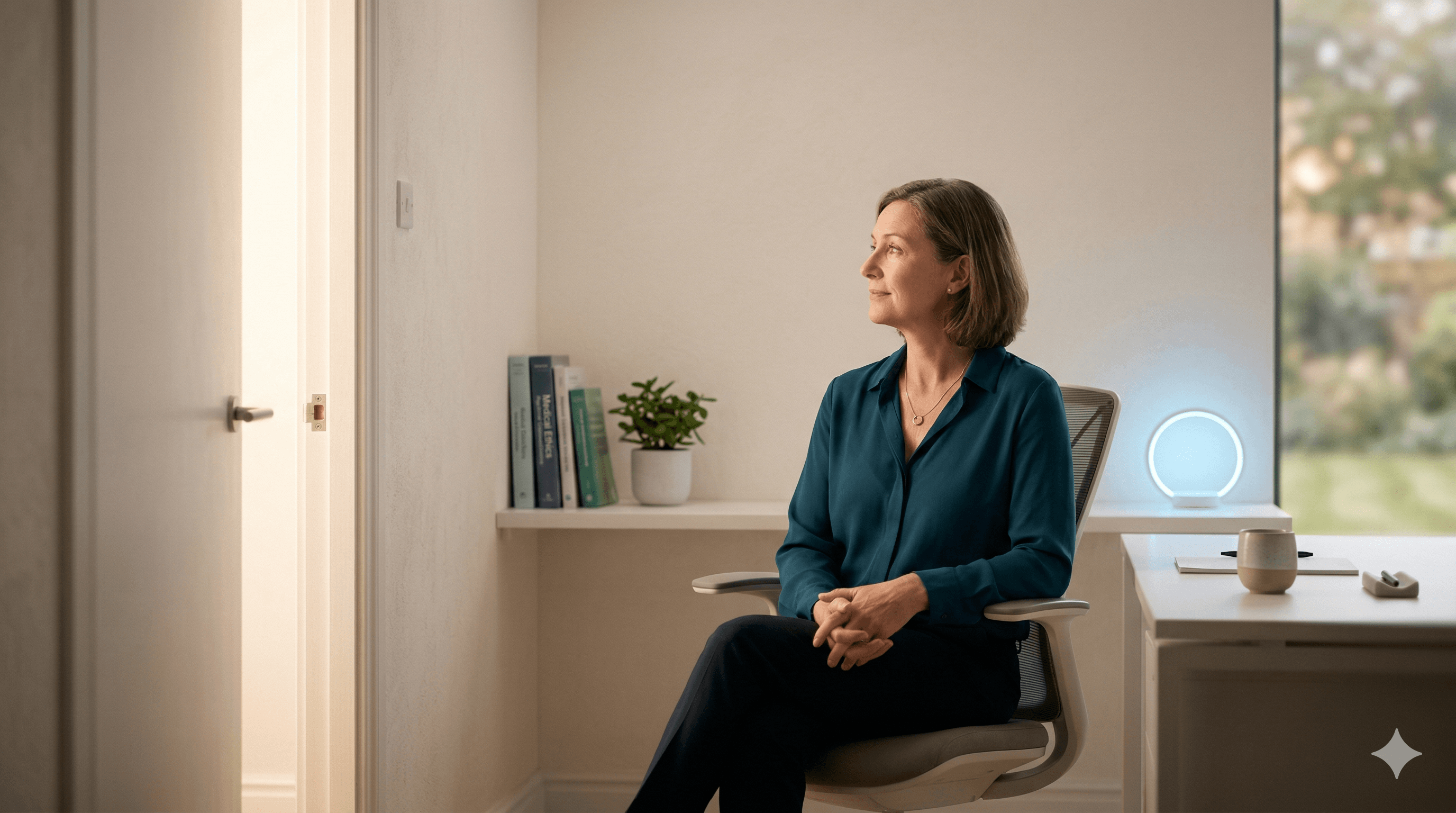
There is a moment in the near future of general practice that deserves serious thought. It is the moment when the AI receptionist has already answered the patient's call, the AI pre-chart has already summarised their record, the ambient scribe is ready to document, the post-visit AI will handle the coding, letters, and follow-up — and the clinician sits in the consultation room, waiting for the patient to walk in.
What, exactly, is the clinician's job in this moment?
The administrative wrapper around the consultation has been delegated. The preparation was automated. The documentation will be generated. The coding will be suggested. The referral letter will be drafted. The patient will receive a summary they did not have to ask for. The follow-up call will happen without anyone scheduling it.
The clinician's job is what remains: the ten minutes in the room.
What Remains Is What Always Mattered Most
The consultation itself — the face-to-face encounter between clinician and patient — is the irreducible core of medicine. It is the part that attracted people to the profession. And it is the part that has been progressively eroded by administrative burden over the past twenty years.
In the AI-wrapped consultation, the clinician is freed to do what they trained for.
Clinical assessment. Seeing the patient, not the screen. Observing body language, affect, and the things the patient is not saying. Performing a targeted examination. Forming a clinical impression based on pattern recognition, experience, and the irreplaceable act of being in the room with another person.
Diagnostic reasoning under uncertainty. General practice is the medicine of undifferentiated presentations. The AI pre-chart provides context, but it cannot determine what this patient's tiredness means today. That requires the clinician's judgement — weighing probability, risk, and the patient's individual circumstances.
Therapeutic communication. Explaining a diagnosis in language the patient understands. Exploring their concerns. Negotiating a management plan that the patient will actually follow. Breaking bad news. Managing expectations. These are human skills that no AI can replicate.
Safety-netting. Telling the patient what to watch for, when to come back, and what would change the clinical picture. This requires the clinician to hold uncertainty without either dismissing it or catastrophising it — a skill that is as much emotional as intellectual.
Professional accountability. Making the decision, owning it, and documenting your reasoning. This is the legal, ethical, and professional core of clinical practice — and it cannot be delegated.
The Liberation
For clinicians who entered medicine to help people, the AI-wrapped consultation is liberating. It removes the burden that was never meant to be the job: the chart-scrubbing, the note-writing, the coding, the letter-drafting, the results-chasing. It returns the consultation to its essential purpose.
Many GPs describe the ambient scribe as the most significant quality-of-life improvement in their careers. NHS England's evaluation of ambient voice technology cites increases in direct patient interaction time. Extend this across the full workflow — pre-charting, scribing, coding, follow-up — and the cumulative effect is transformative.
The clinician is not diminished by AI support. They are concentrated. Every minute of their working day is focused on clinical reasoning and human connection rather than administrative processing.
The Vulnerability
But there is a vulnerability in this model, and it deserves honest acknowledgement.
Deskilling. If the AI pre-chart tells you the diagnosis and the management plan, and the scribe documents what you say, and the post-visit AI codes and letters — at what point do you stop building the skills that the AI is substituting for? A newly qualified GP who has never had to review a complex chart manually may lack the skill when the AI system fails. A trainee who relies on AI-suggested differentials may not develop the independent reasoning that training exists to build.
Over-reliance. The more the AI handles, the more natural it becomes to trust it. The moment a clinician stops verifying the pre-chart, stops reviewing the AI-generated note, stops checking the coding suggestion — that is the moment when AI support becomes AI dependency. And dependency on a system that can hallucinate, omit, and err is clinically dangerous.
Loss of the "mundane" learning. Much of clinical wisdom is acquired through the boring parts: reviewing old records, writing letters, chasing results, reading discharge summaries. These tasks build familiarity with the patient, understanding of the system, and the kind of contextual knowledge that cannot be taught in a classroom. If the AI absorbs all of this, the clinician may know the patient less well, not more.
Professional identity. If the machine handles everything except the consultation, what distinguishes the clinician from a highly trained conversationalist? The answer is clinical expertise — the knowledge, reasoning, and accountability that justify the professional title. But that expertise must be actively maintained. It does not persist automatically in a world where AI handles the retrieval, synthesis, and application of clinical information.
How to Stay Sharp in an AI-Wrapped World
This is where tools like iatroX become essential not just as point-of-care references but as learning platforms.
The Q-Bank, with its spaced repetition and active recall algorithms, keeps clinical knowledge durable and current. In a world where you are no longer forced to look things up manually, you need a deliberate learning practice that ensures your knowledge does not atrophy.
The Brainstorm tool maintains your clinical reasoning skills by walking you through scenarios step by step. This is the practice that keeps you capable of independent reasoning even when the AI is providing suggestions.
The CPD module turns everyday clinical queries into documented professional development — ensuring that the learning that used to happen incidentally through administrative work now happens deliberately through structured reflection.
The AI wraps the consultation. The clinician must ensure they remain sharp enough to deserve the seat in the middle.
Conclusion
The AI-wrapped consultation is coming. For some clinicians, it is already here in pieces — a scribe documenting, a triage tool routing, a reference tool answering. The full version, where AI handles the entire workflow except the human encounter, is the logical endpoint.
The clinician's role in that world is not smaller. It is more focused, more demanding, and more dependent on genuine clinical expertise than at any point in modern medicine. The AI handles the administration. The clinician handles the judgement. That is a better division of labour for everyone — provided the clinician invests in maintaining the expertise that the AI is built to support.