Introduction
The question is no longer "should doctors use ChatGPT?" The reality is that many already are. The real question is: how can clinicians use this powerful tool safely, effectively, and professionally? While ChatGPT offers incredible utility for drafting and summarising, it lacks the medical grounding and safety guardrails required for clinical decision-making.
This article provides a clear, practical framework for using ChatGPT in clinical practice. We outline the "safe zones" where it can save you hours of administrative time, the "red zones" where it poses a significant risk to patient safety and confidentiality, and how specialised tools like iatroX offer a safer, citation-first alternative for clinical queries.
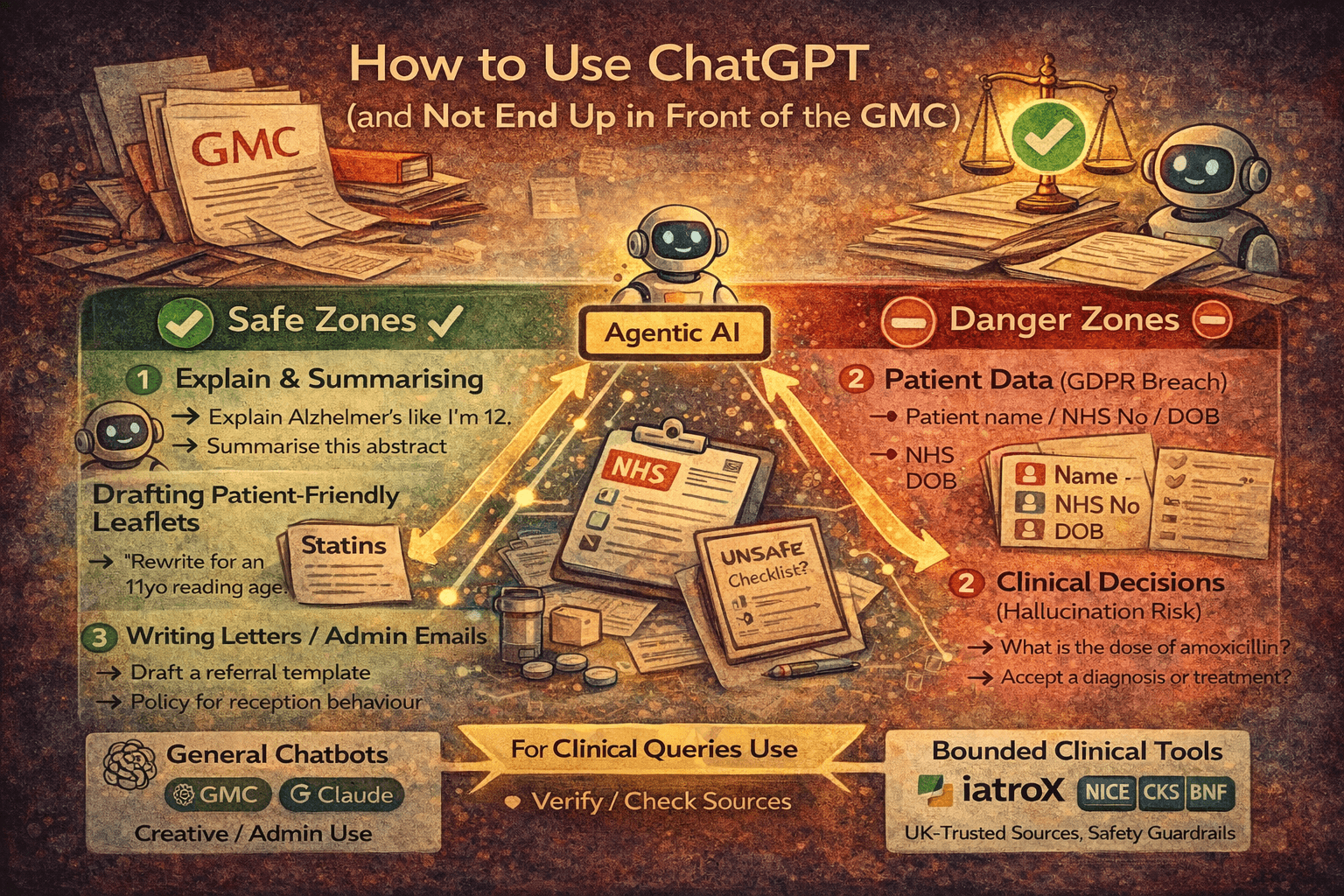
The 3 “safe” use-cases
You can use ChatGPT safely if you treat it as an administrative assistant, not a medical consultant.
1. Explaining terminology & summarising non-identifiable text
ChatGPT excels at translation. You can ask it to "explain the mechanism of action of SGLT2 inhibitors in simple terms" or "summarise this abstract into three bullet points." As long as no patient data is involved, it is a powerful learning and reading aid.
2. Drafting patient-friendly leaflets
One of the most valuable uses is simplifying complex medical jargon.
- Prompt: "Rewrite this paragraph about statins to be understandable for a patient with a reading age of 11. Focus on the benefits and common side effects."
- The Caveat: You must review the output for accuracy. ChatGPT can occasionally simplify a concept to the point of inaccuracy.
3. Admin writing (letters, emails, policies)
This is the biggest time-saver. Use it to draft:
- Practice policies or protocols (e.g., "Draft a policy for managing aggressive behaviour at reception").
- Difficult emails to colleagues or rotas.
- Anonymised referral letter templates.
The red zone: what you should avoid
Patient-identifiable data (PID)
Never paste a patient's name, NHS number, date of birth, or even a highly specific clinical history into a public chatbot. These platforms use data for training, and you have no control over where that information goes. It is a serious breach of confidentiality and GDPR.
Over-trust in clinical outputs
ChatGPT is a probabilistic engine, not a knowledge base. It predicts the next likely word, not the next true fact.
- The Risk: It can "hallucinate" plausible but incorrect drug doses, invent guidelines that don't exist, or reference papers that were never written.
- The Rule: Do not use a general-purpose chatbot for clinical decision support (e.g., "What is the dose of amoxicillin for a 5-year-old?"). The risk of error is too high.
A safer alternative pattern: “general chatbot” vs “bounded clinical tools”
The market is splitting into two distinct categories:
- General Chatbots (ChatGPT, Claude): Excellent for creative, administrative, and drafting tasks where "voice" matters more than "fact."
- Bounded Clinical Tools: Specialised AI designed for healthcare. These tools use a "bounded" knowledge base (only reading from trusted sources) and are programmed to cite their work.
Where iatroX fits
iatroX is designed to fill the gap where ChatGPT is unsafe. It is not a general chatbot; it is a clinical workflow tool.
- Grounded Q&A: Unlike ChatGPT, iatroX answers clinical questions by retrieving information directly from authoritative UK sources like NICE, CKS, and the SmPC/emc.
- Citations: Every answer comes with a direct link to the source, allowing you to verify the information instantly.
- Safety: It is designed to "abstain" from answering if it cannot find a trustworthy source, rather than guessing.
Use ChatGPT to write the patient letter; use iatroX to check the guideline that informs the decision.
Frequently Asked Questions
Can I use ChatGPT to write clinical notes? Only if you are using an approved, enterprise-grade version with a data processing agreement in place. Never paste patient details into the free, public version.
Is it safe to ask ChatGPT for a differential diagnosis? You can use it for brainstorming generic differentials (e.g., "What are the causes of hypercalcaemia?"), but verify every suggestion against a trusted source. Do not rely on it for a specific patient's diagnosis.
Does ChatGPT cite its sources? The standard version does not reliably cite sources and often fabricates them. Tools like iatroX are built specifically to solve this "provenance problem" in healthcare.