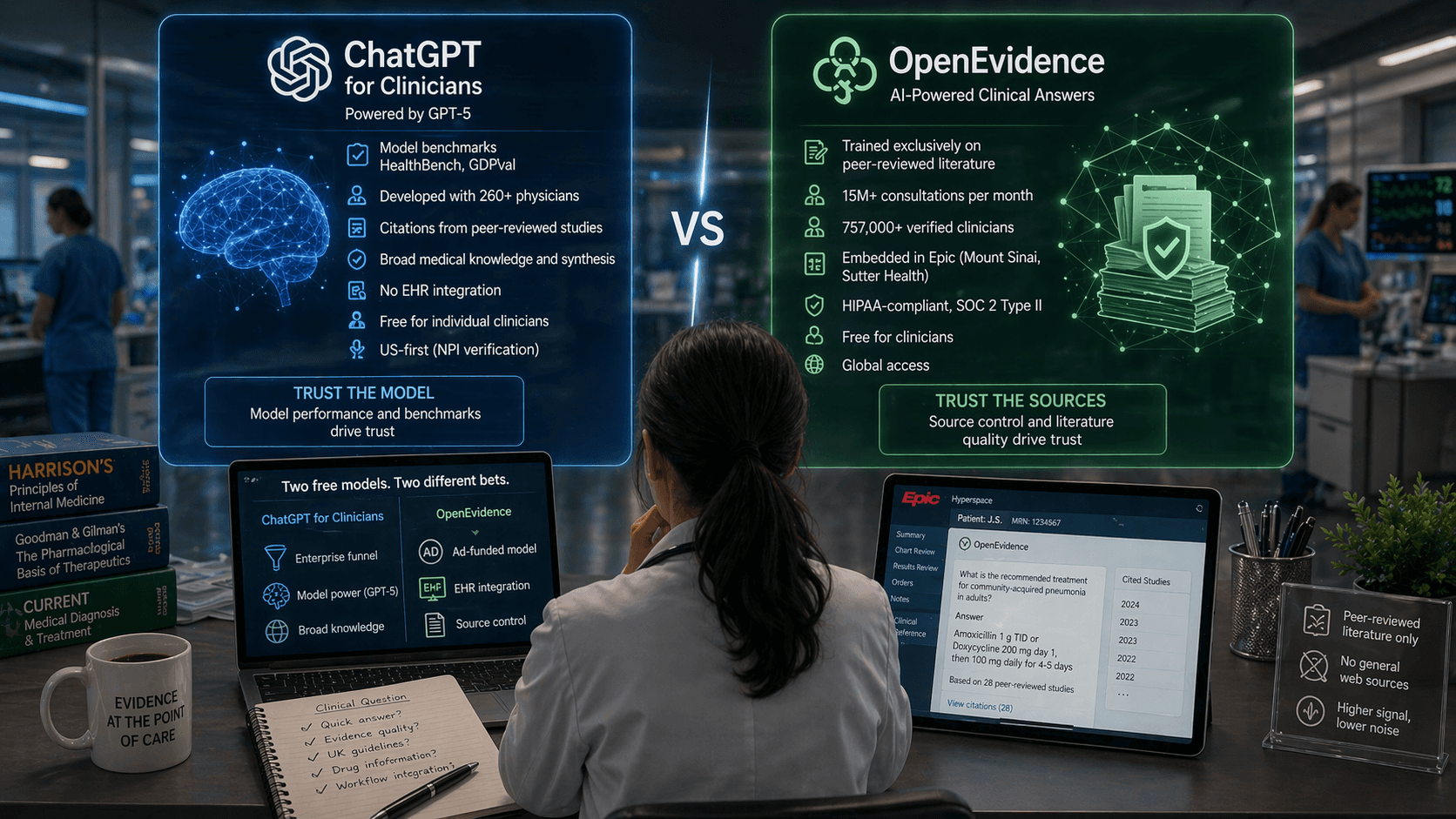
Two free clinician-facing AI tools now compete for daily use by working doctors. ChatGPT for Clinicians, launched by OpenAI on 22 April 2026, enters a market where OpenEvidence already processes approximately 15 million clinical consultations per month from over 757,000 verified clinicians. Both are free. Both target individual physicians. The approaches to trust, evidence grounding, and revenue differ fundamentally.
Business Model
ChatGPT for Clinicians is free as part of OpenAI's three-tier healthcare stack (consumer → individual clinician → enterprise). The revenue model for this specific product is unclear — most likely a funnel to ChatGPT for Healthcare, the enterprise product deployed at AdventHealth, HCA, Cedars-Sinai, and five other major US institutions at custom enterprise pricing. OpenAI does not need this product to generate revenue directly; it needs it to build clinician familiarity with GPT-5 before selling the enterprise product to their hospitals.
OpenEvidence is free and ad-funded. Pharmaceutical companies pay to advertise during loading screens while answers generate — CPMs reportedly in the $70-150+ range, orders of magnitude higher than consumer social media advertising. OpenEvidence reached $100 million in annualised revenue by January 2026 on a $12 billion valuation, backed by approximately $700 million in total funding from GV, Sequoia, NVIDIA, Kleiner Perkins, Blackstone, and Mayo Clinic. This is the "Google Ads of clinical AI" — pharma pays for access to prescribers at their moment of clinical decision-making.
Trust Architecture
ChatGPT for Clinicians builds trust through model benchmarks — GPT-5 evaluated via HealthBench and GDPval (physician-written rubrics), developed with 260+ physicians, citations from peer-reviewed studies. But the same model family powers ChatGPT Health, which the Nature Medicine study (Ramaswamy et al., February 2026) found under-triaged 52% of gold-standard emergencies.
OpenEvidence builds trust through source control — proprietary models (not ChatGPT) trained exclusively on peer-reviewed medical literature, not the broader internet. HIPAA-compliant, SOC 2 Type II certified. The trust proposition is different: ChatGPT says "trust the model." OpenEvidence says "trust the sources we trained it on."
EHR Integration — OpenEvidence's Structural Advantage
In March 2026, OpenEvidence was embedded into Mount Sinai's Epic system — the first enterprise-wide deployment across the entire care team. Sutter Health announced an Epic collaboration in February 2026. When a clinician using Epic has a clinical question, OpenEvidence answers are accessible within the EHR — no tab-switching, no workflow disruption.
ChatGPT for Clinicians has no EHR integration for the individual product. For the individual clinician, it is a separate browser tab — a meaningful workflow disadvantage at the point of care.
Citation Quality
ChatGPT for Clinicians draws from broad medical literature and automatically selects sources. Breadth is a strength — millions of potential citations. But the model may hallucinate citations or cite outdated studies.
OpenEvidence cites exclusively from peer-reviewed medical literature — no general web sources. Narrower but more controlled — higher clinical signal-to-noise ratio.
International Availability and the UK Gap
ChatGPT for Clinicians appears US-first (NPI verification). OpenEvidence is globally accessible but US-evidence-centric.
Neither is purpose-built for UK practice. Neither retrieves NICE guidelines, CKS, or SmPC data. iatroX is the UK-native alternative: MHRA-registered, NICE/CKS/literature/SmPC-grounded, free, with 15+ adaptive exam Q-banks and 80+ clinical calculators.
Market Implications
Two free, well-funded clinician AI tools creates a pincer movement on paid tools — particularly UpToDate at $500+/year. The ad-funded model (OpenEvidence) versus the enterprise-funnel model (OpenAI) represents two different bets on monetisation. EHR integration (OpenEvidence in Epic) versus model power (GPT-5) represents two different bets on what drives adoption.
Both bets may be right. The market is large enough for multiple winners — but the losers will be paid tools that cannot justify their price when free alternatives are good enough for daily use.
For UK-guideline-aligned clinical AI: Try Ask iatroX (free, MHRA-registered) →