Executive summary
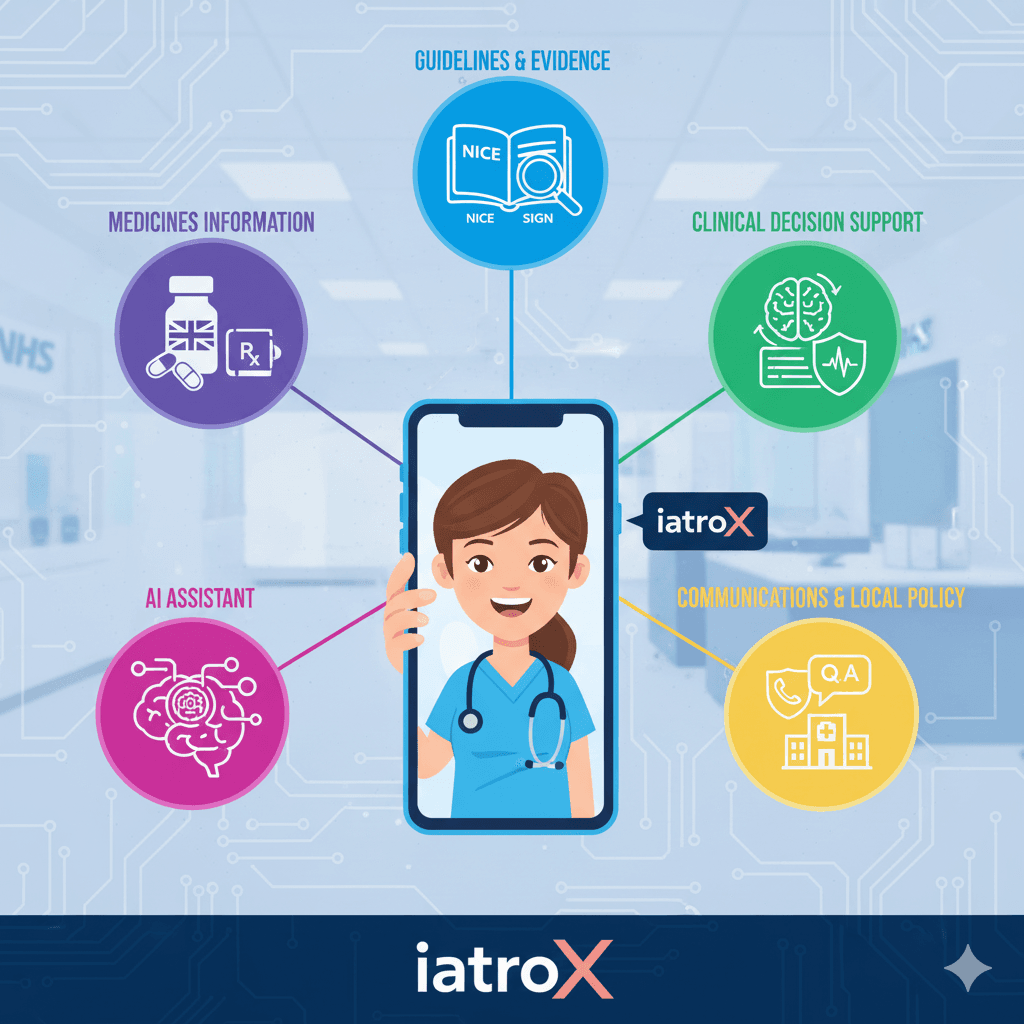
The modern UK clinical toolkit is a sophisticated stack of digital resources designed to deliver faster, safer decisions at the point of care. This landscape is broadly clustered into essential medicines information, national guidelines and evidence, clinical decision support, secure communications, and specialist reference tools.
The non-negotiable essentials for any frontline clinician remain the BNF/BNFC app for prescribing and the core evidence base of NICE guidelines and CKS summaries. These are supplemented by powerful point-of-care compendia like UpToDate and BMJ Best Practice. For communications, Accurx is the standard. Layered on top, AI assistants like iatroX provide a UK-centric, citation-first approach to exploring the wider evidence base. For local policy, MicroGuide is key, while SPS, UKTIS, and other specialist services provide vital safety information.
Who this guide is for (and how to use it)
This guide is for all frontline UK clinicians: GPs, Advanced Clinical Practitioners (ACPs), hospital doctors, pharmacists, Physician Associates (PAs), and community nursing teams. The most effective way to use this guide is to build your personal toolkit by pairing one primary medicines source + one core guidelines source + one clinical decision support tool + your local communications app. You can then layer on a UK-grounded AI assistant and a trusted calculator bundle to complete your stack.
Medicines information (non-negotiables)
- BNF & BNFC (official NICE apps): The definitive source for UK prescribing standards, including dosing, contraindications, and interactions. The official mobile apps provide crucial offline access and are free for NHS users.
- MedicinesComplete: A comprehensive, subscription-based suite from the Royal Pharmaceutical Society, essential for hospital and specialist pharmacy teams, which includes deep resources like Stockley’s Drug Interactions and Martindale.
- Specialist Pharmacy Service (SPS): The NHS-commissioned “first stop” for expert medicines advice, providing practical implementation know-how for complex queries.
Guidelines & evidence (national)
- NICE Guidance: The source of evidence-based national recommendations that underpin UK care pathways and policy.
- NICE CKS (Clinical Knowledge Summaries): Practical, primary-care-focused summaries of over 370 common clinical topics.
- SIGN (Scotland): The Scottish Intercollegiate Guidelines Network provides highly-respected national guidelines that are a valuable resource for all UK clinicians.
Point-of-care clinical decision support (CDS)
- UpToDate: A leading global clinical reference, offering deep dives into a vast range of topics, with integrated calculators and pathway tools.
- BMJ Best Practice: A UK-friendly, structured summary tool designed around the clinical consultation. It is free for all NHS staff and learners via OpenAthens and has an excellent offline app.
- DynaMed: A KLAS-rated evidence-synthesis tool with a strong reputation and growing use in UK trusts.
AI assistants & search—UK-centric options
- iatroX (free): A UK-focused clinical assistant. The Ask iatroX feature provides citation-first answers grounded in sources like SIGN guidelines and peer-reviewed research. The platform also includes an adaptive Quiz engine mapped to UK curricula and a CPD logging tool. It is designed to complement your use of core resources like NICE and the BNF by providing a rapid, conversational layer for exploring the wider evidence base.
Communications & workflow
- Accurx: The standard for NHS-approved, secure communication between primary and secondary care, and between clinicians and patients. Its rebranded “Switch” app provides a valuable hospital directory and secure HCP-to-HCP messaging.
- Consultant Connect: Widely used across the NHS for Advice & Guidance, secure photo sharing, and patient triage.
- Induction Zesty: A powerful patient portal for managing appointments, digital letters, and forms, with deep integrations into the NHS App and NHS login.
Antimicrobial & local policy
- MicroGuide: The essential app for accessing your local Trust or ICB's antimicrobial guidance and other policies, with full offline access.
- Medusa (NHS Injectable Medicines Guide): The definitive resource for the safe preparation and administration of IV medications.
Risk calculators & scores
- MDCalc: A comprehensive library of medical calculators and clinical scores, widely used at the point of care.
- QRISK3: The official, NICE-recommended calculator for assessing 10-year cardiovascular risk.
Pharmacy-first & safety
- MHRA Drug Safety Update & Yellow Card: The essential monthly bulletin for safety signals and the national system for reporting adverse drug reactions.
- UKTIS / BUMPS (medicines in pregnancy) & TOXBASE (toxicology): The UK's specialist advisory services for medicines in pregnancy and poisoning.
Role-based quick picks
- GP / ACP: BNF app + NICE CKS + Accurx + iatroX + MicroGuide + MDCalc/QRISK.
- Hospitalist / Registrar: BNF app + UpToDate/DynaMed + Consultant Connect + Medusa + MicroGuide + iatroX.
- Pharmacist: MedicinesComplete (Stockley’s) + SPS + BNF/BNFC + MHRA DSU/Yellow Card + UKTIS/TOXBASE; iatroX for cited guideline context.
Implementation tips (governance & efficiency)
- Procure with assurance: Prioritise tools with a clear evidence methodology, robust UK data governance, and an established presence on NHS procurement frameworks.
- Minimise app-sprawl: Choose one primary tool per category and standardise across your team. Integrate with NHS login or OpenAthens where possible to reduce login friction.
- Layer AI safely: Use UK-gated, citation-first assistants like iatroX to support—not replace—your own clinical judgement and your use of core resources like the BNF and CKS.
FAQs
- Is BMJ Best Practice free for NHS staff?
- Yes. Access is nationally funded via your NHS OpenAthens account, which also unlocks the full mobile app with offline content.
- Which AI tools show their sources?
- Tools like iatroX and others in the modern RAG-based category are designed to be "citation-first," providing direct links to their source material.
- Where should I check local antibiotic guidance?
- Your definitive local source will be on your organisation's MicroGuide app.
Calls to action
- Download & set up the core five today: The BNF app, a bookmark to NICE CKS, one primary CDS (UpToDate, BMJ, or DynaMed), one communications app (Accurx or Consultant Connect), and iatroX for UK-cited AI look-ups.
- Audit your current stack: As a team, review the digital tools you are currently using. Identify any duplication and align every tool to a defined workflow outcome, such as time saved, fewer referral errors, or safer prescribing.