Introduction
The question "what guidelines should I follow?" is surprisingly complex. In the UK, clinicians navigate a web of national bodies (NICE, SIGN), specialty societies (BTS, BASHH), and local Trust policies. Knowing which source takes precedence in which scenario is a core skill for safe practice.
This guide provides a pragmatic "source hierarchy" for 2026. We break down the differences between NICE, CKS, and SIGN, explain what to do when local pathways conflict with national advice, and show how AI tools like iatroX can help you navigate this complexity without compromising on safety.
Why “best” depends on the question
There is no single "best" guideline. The right source depends entirely on the clinical task:
- Diagnosis: National guidelines (NICE/SIGN) set the gold standard.
- Prescribing: The BNF and local formularies dictate safety and availability.
- Referral: Local ICB/Trust pathways determine how and where to refer.
- Prevention: National screening programmes and UKHSA (e.g., Green Book) lead on public health.
The UK hierarchy (simple mental model)
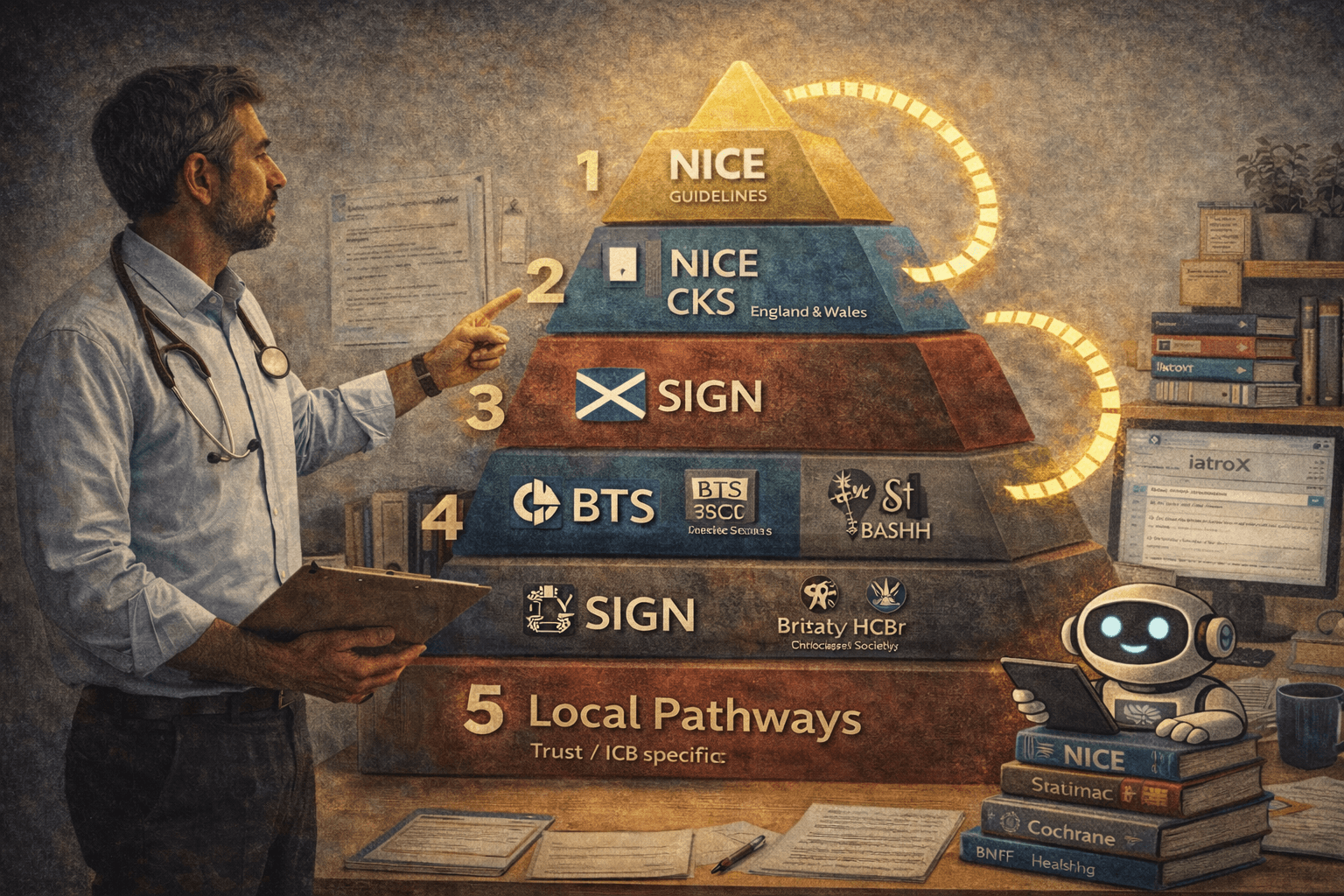
Think of clinical guidance as a pyramid.
1. NICE Guidelines (England/Wales)
National Institute for Health and Care Excellence (NICE) guidelines are the bedrock. They are comprehensive, evidence-based recommendations that underpin NHS care.
- Use for: Understanding the full evidence base, policy decisions, and complex care pathways (NICE).
2. NICE CKS (Primary Care)
Clinical Knowledge Summaries (CKS) are practical interpretations of NICE guidance, designed specifically for primary care.
- Use for: Rapid, "what do I do now?" management steps for common conditions (NICE CKS).
3. SIGN (Scotland)
Scottish Intercollegiate Guidelines Network (SIGN) guidelines are rigorous and evidence-based. While produced for Scotland, they are respected UK-wide and often cover topics in greater clinical depth than NICE.
- Use for: Detailed clinical management, especially where NICE guidance is older or less specific (Sign.ac.uk).
4. Royal Colleges & Specialty Societies
Bodies like the British Thoracic Society (BTS) or BASHH produce highly specialised guidelines.
- Use for: Niche or specialist conditions where national guidance is too broad (e.g., specific asthma phenotypes or sexual health).
5. Local Trust/ICB Pathways
These operationalise national guidance for your local system.
- Use for: Prescribing (formulary choices), referrals, and admission criteria.
When to choose CKS vs NICE guideline (decision tree)
- Scenario A: Routine GP Consult. Patient with new hypertension.
- Choice: CKS. It gives you the immediate step-by-step protocol for diagnosis and first-line treatment.
- Scenario B: Complex Comorbidity. Patient with hypertension, CKD, and heart failure who is intolerant to ACEi.
- Choice: NICE Guideline (NG136). CKS might be too simplified. The full guideline explains the evidence for second-line choices in complex patients (NICE).
What to do when local pathways differ from national guidance
This is a common friction point. NICE might recommend a new, expensive drug, but your local formulary says "No."
- The Rule: For prescribing and referrals, local policy usually takes precedence because it reflects commissioned services and funding.
- The Exception: If you believe local policy is unsafe or significantly outdated compared to a major new national guideline, you should follow your clinical judgement, document your reasoning clearly ("Deviated from local policy due to new NICE evidence NG..."), and raise it as a clinical governance issue.
Where AI tools fit safely
AI tools can act as a "meta-layer" to help you navigate this hierarchy.
iatroX: UK-first collation
iatroX is designed to understand this UK hierarchy.
- Cited Answers: When you ask a question, it prioritises NICE, CKS, and the BNF.
- Conflict-Aware: If a NICE guideline says one thing and the BNF says another (e.g., on a drug dose), a good AI tool should surface this conflict rather than hiding it. iatroX is built to present the UK default while flagging divergence (iatroX, Google Play).
OpenEvidence: Literature Grounding
OpenEvidence is excellent for "orientation"—finding the evidence base behind a guideline. It is less tuned to the specific operational hierarchy of the NHS (e.g., it won't know your local Trust's referral form), but it is powerful for understanding the global standard of care (Google Play, App Store).
FAQ
Does NICE apply in Scotland? No. Scotland follows SIGN guidelines. However, where no SIGN guideline exists, NICE guidance is generally accepted as best practice. NICE Technology Appraisals (TAs) have a specific status and are often adopted by the Scottish Medicines Consortium (SMC).
CKS vs NICE guideline? CKS is a summary for primary care. It is derived from the full NICE guideline. Always use CKS for speed and the full NICE guideline for depth or complex cases.