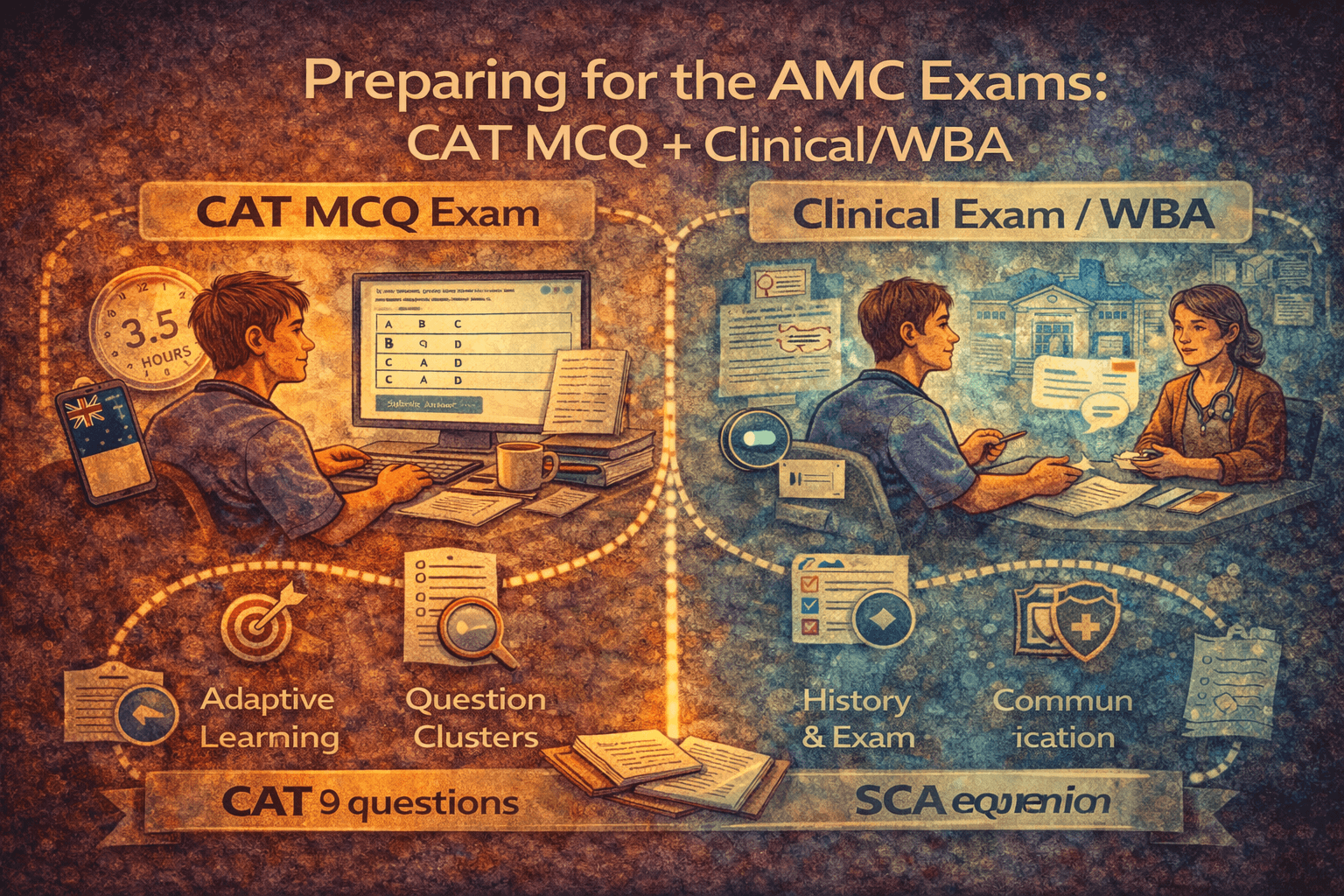
If you’re preparing for the Australian Medical Council (AMC) assessments, “doing questions” is necessary — but not sufficient.
The AMC CAT MCQ rewards breadth, judgement, and pacing under a fixed 3.5-hour rhythm, while the clinical exam (or workplace-based assessment, WBA) rewards structured clinical performance that looks and feels like safe Australian practice.
This article explains the pathway in plain English, what an AMC qbank must deliver, how to build an adaptive plan that actually improves scores, and how to avoid the most common “false progress” traps.
This is educational guidance, not official pathway advice. Always confirm your current pathway requirements and eligibility with the Medical Board of Australia/AHPRA and the AMC.
The Australian pathway in plain English (who sets what: Medical Board/AHPRA vs AMC)
Think of Australia’s system as two different roles:
1) The Medical Board of Australia (via AHPRA) regulates registration
The Medical Board of Australia (supported by AHPRA) sets the rules for registration pathways for international medical graduates (IMGs) and grants registration decisions.
For example, on the standard pathway, you’ll typically need AMC assessments (and then supervised practice/registration steps depending on your stage).
Start here (official):
- Standard pathway overview (Medical Board): https://www.medicalboard.gov.au/Registration/International-Medical-Graduates/Standard-Pathway.aspx
- IMG pathways hub: https://www.medicalboard.gov.au/Registration/International-Medical-Graduates.aspx
2) The AMC manages assessment for the standard pathway
The AMC runs the assessments for the standard pathway, but it does not grant registration — that remains the Board’s role.
Official AMC pathway overview:
- AMC pathways and roles: https://www.amc.org.au/pathways/
- Standard pathway (AMC): https://www.amc.org.au/pathways/standard-pathway/
Where the CAT MCQ + clinical/WBA fits
On the standard pathway, the Medical Board describes two main routes to the AMC Certificate after the CAT MCQ:
- AMC examinations route: CAT MCQ + AMC clinical examination
- WBA route: CAT MCQ + AMC-accredited WBA program (places can be limited and you typically complete WBA after you’ve been granted registration)
See (Medical Board):
https://www.medicalboard.gov.au/Registration/International-Medical-Graduates/Standard-Pathway.aspx
What AMC-style q-banks need (breadth + decision-making; timed CAT rhythm)
An AMC CAT MCQ question bank should train two things at once:
- clinical breadth (across core disciplines), and
- exam decision-making under time pressure (because it’s CAT and time-limited).
The AMC CAT MCQ format you must train for
Officially, the AMC CAT MCQ examination is:
- delivered in one 3.5-hour session
- 150 multiple-choice questions, one best answer from five options
See (AMC):
https://www.amc.org.au/pathways/standard-pathway/amc-assessments/mcq-examination/
The CAT format makes pacing and consistency matter. If you run out of time or leave many questions incomplete, you can sabotage your result even if your knowledge base is strong.
Content coverage: what your qbank must simulate
AMC describes the MCQ content as covering essential medical knowledge including:
- disease processes
- clinical examination and diagnosis
- investigation, therapy, and management
See (AMC):
https://www.amc.org.au/pathways/standard-pathway/amc-assessments/mcq-examination/
A strong AMC qbank should therefore include:
- mixed discipline blocks (not only topic-by-topic)
- management decisions (not just diagnosis recognition)
- Australian-flavoured safety habits (risk, escalation, “do the basics well”)
A practical qbank checklist for AMC CAT MCQ
When choosing between AMC qbanks, look for:
- breadth and blueprint logic (not a narrow “high-yield” myth)
- explanations that teach decision-making, not just the correct option
- timed exam mode that matches the 3.5-hour rhythm and 150-question pacing
- analytics that identify weak areas you can act on (not just a score)
- errata/corrections process (how errors are reported and fixed)
- mobile UX that supports daily consistency
A note on “official” practice questions
The AMC has also introduced a free MCQ preparation app (with a set of practice questions and annual refresh). This is useful as a baseline to calibrate your understanding of style — but most candidates still need a larger qbank for volume and repetition.
See (AMC MCQ preparation app):
https://www.amc.org.au/mcq-preparation-app/
Adaptive learning for AMC: “knowledge gaps → question clusters → retest schedule”
“Adaptive learning” is only valuable if it changes what you practise next and when you revisit it.
For AMC preparation, a high-performing adaptive loop looks like this:
Step 1: identify knowledge gaps (fast but honest)
Use timed mixed sets to surface genuine weak areas. Don’t start with comfort topics.
Output of this step should be a short list like:
- 8–12 weak topics (e.g., paeds fever, asthma/COPD decisions, psych risk, O&G bleeding, surgical abdomen)
- 3–5 repeated error patterns (e.g., missed red flags, wrong first-line management, poor test selection)
Step 2: convert gaps into question clusters
Instead of “doing more questions”, do targeted clusters:
- cluster by topic (e.g., “chest pain management”)
- cluster by skill (e.g., “next best investigation”)
- cluster by error type (e.g., “anchoring early on diagnosis”)
Step 3: retest schedule (this is where the gains happen)
Re-test the same weakness clusters on a schedule until they stabilise:
- 48 hours after first failure (early reinforcement)
- 7 days later (spaced consolidation)
- 14 days later (longer retention)
- then mix into random timed sets to ensure transfer
If your platform does not help you execute this loop, you must build it yourself using:
- “incorrect” queues
- tagged lists
- calendar scheduling
How to avoid “false progress” (doing only familiar topics; not timing)
Most candidates don’t fail because they lack intelligence. They fail because they unintentionally train the wrong behaviour.
The false progress traps (and their fixes)
Trap 1: only revising familiar topics
Symptom: your % correct looks good, but your score doesn’t move on mixed mocks.
Fix: force 60–80% of practice to be mixed, timed sets.
Trap 2: untimed practice until the last minute
Symptom: you know the answers, but you run out of time or make rushed mistakes.
Fix: timed practice from week 1. Train pacing as a skill.
Trap 3: reading explanations without changing your decision rules
Symptom: you keep missing the same concept in new stems.
Fix: convert misses into “rules” you apply under pressure, e.g.:
- “If X red flag appears, escalation beats reassurance.”
- “If unstable, resuscitate before diagnosis.”
- “If antibiotic choice is borderline, check contraindications and local rationale.”
Trap 4: questions without review loops
Symptom: volume increases, but weak topics remain weak.
Fix: the 24–48 hour “incorrect review” is non-negotiable.
Where iatroX fits (adaptive q-bank + analytics; “progressive difficulty”)
iatroX is best used as the layer that turns “I got it wrong” into “I won’t get it wrong again”.
In an AMC workflow, iatroX can be positioned as:
- an adaptive q-bank layer (to drive repeated exposure to weak clusters)
- an analytics layer (to convert performance into an action plan)
- a progressive difficulty loop (starting with core decision patterns, then increasing complexity)
A practical hybrid workflow many candidates find effective:
- do a timed mixed set (AMC qbank)
- review incorrects and label the error pattern
- use iatroX to clarify the underlying concept and common traps
- retest with a targeted cluster within 48 hours
- schedule spaced retests at 7 and 14 days
This approach reduces random “question grinding” and increases purposeful repetition.
8-week plan template (CAT MCQ focused, with a clinical/WBA runway)
This is a realistic plan if you can commit most days.
Weeks 1–2: build the base + timing discipline
- 5 days/week: timed sets (start smaller, build)
- 2 days/week: deeper review blocks (incorrects + weak-topic notes)
- build your weakness list (topics + error patterns)
- start an “incorrects retest” rhythm (48h / 7d)
Target output by end of week 2:
- consistent timing comfort
- clear top 10 weaknesses
- repeat errors identified
Weeks 3–6: adaptive intensity (the score-moving phase)
- 4–5 days/week: timed mixed sets
- 2–3 targeted cluster sessions/week (weak topics + repeat errors)
- 1 mock-style long session/week to rehearse pacing stamina
- tighten review loops: incorrects within 24–48 hours
Weeks 7–8: exam simulation + consolidation
- 2 full-length exam-mode sessions/week (timed, distraction-free)
- aggressive weak-area retesting (do not “revise what you like”)
- light content expansion only if a new weakness appears repeatedly
Clinical/WBA runway:
- begin structured clinical rehearsal now (history, examination sequence, safety-netting language)
- even 2–3 cases/week out loud helps reduce the future jump
12-week plan template (more sustainable, better for busy rotations)
This plan is safer if you have work constraints, or if you want to reduce burnout risk.
Weeks 1–4: breadth + habits
- 4 days/week: timed mixed sets (shorter sessions are fine)
- 2 days/week: review + “rules” building
- set up your adaptive system (weak clusters + retest scheduling)
Weeks 5–9: adaptive build (clusters + spaced repetition)
- maintain timed sets
- 2–3 targeted cluster sessions/week
- add one stamina session every 10–14 days
- lock in your review loop
Weeks 10–12: performance mode
- increase simulation frequency
- reduce new content chasing
- focus on:
- pacing
- avoiding repeat errors
- applying rules under time pressure
Clinical/WBA runway:
- do 1–2 structured clinical sessions/week (cases out loud, timed)
- practise communication that fits Australian expectations: clarity, safety-netting, escalation, respectful uncertainty
FAQ (real queries)
“Best AMC qbank: which one should I choose?”
Choose based on features, not marketing:
- timed exam mode that matches CAT rhythm
- strong explanations
- analytics that drive a plan
- visible errata/corrections
- usability on mobile (daily consistency matters)
Also consider using the AMC’s free MCQ preparation app as a baseline reference for style: https://www.amc.org.au/mcq-preparation-app/
“AMC CAT MCQ practice: how many questions do I need?”
There is no magic number. Many candidates do best when they prioritise:
- timed mixed practice
- ruthless review loops
- repeated retesting of weak clusters
The return on time comes from the adaptive loop, not raw volume.
“AMC exam practice questions: should I do topic blocks or mixed blocks?”
Do both, in this order:
- start mixed to reveal true weaknesses
- use topic blocks to repair weak clusters
- return to mixed sets to ensure transfer under exam conditions
“Medical Board of Australia standard pathway: who do I follow for the rules?”
- For registration pathway rules and steps: Medical Board of Australia / AHPRA
https://www.medicalboard.gov.au/Registration/International-Medical-Graduates/Standard-Pathway.aspx - For assessment format, specifications, and AMC certificate requirements: AMC
https://www.amc.org.au/pathways/standard-pathway/
“AMC clinical exam preparation: when should I start?”
Earlier than most people think. Even while focusing on CAT MCQ, start light but consistent clinical rehearsal:
- practise structured history and exam sequences
- rehearse safety-netting and escalation phrases
- do cases out loud (performance skill)
The AMC clinical exam is a separate skillset; leaving it until after MCQ can create a stressful second peak.