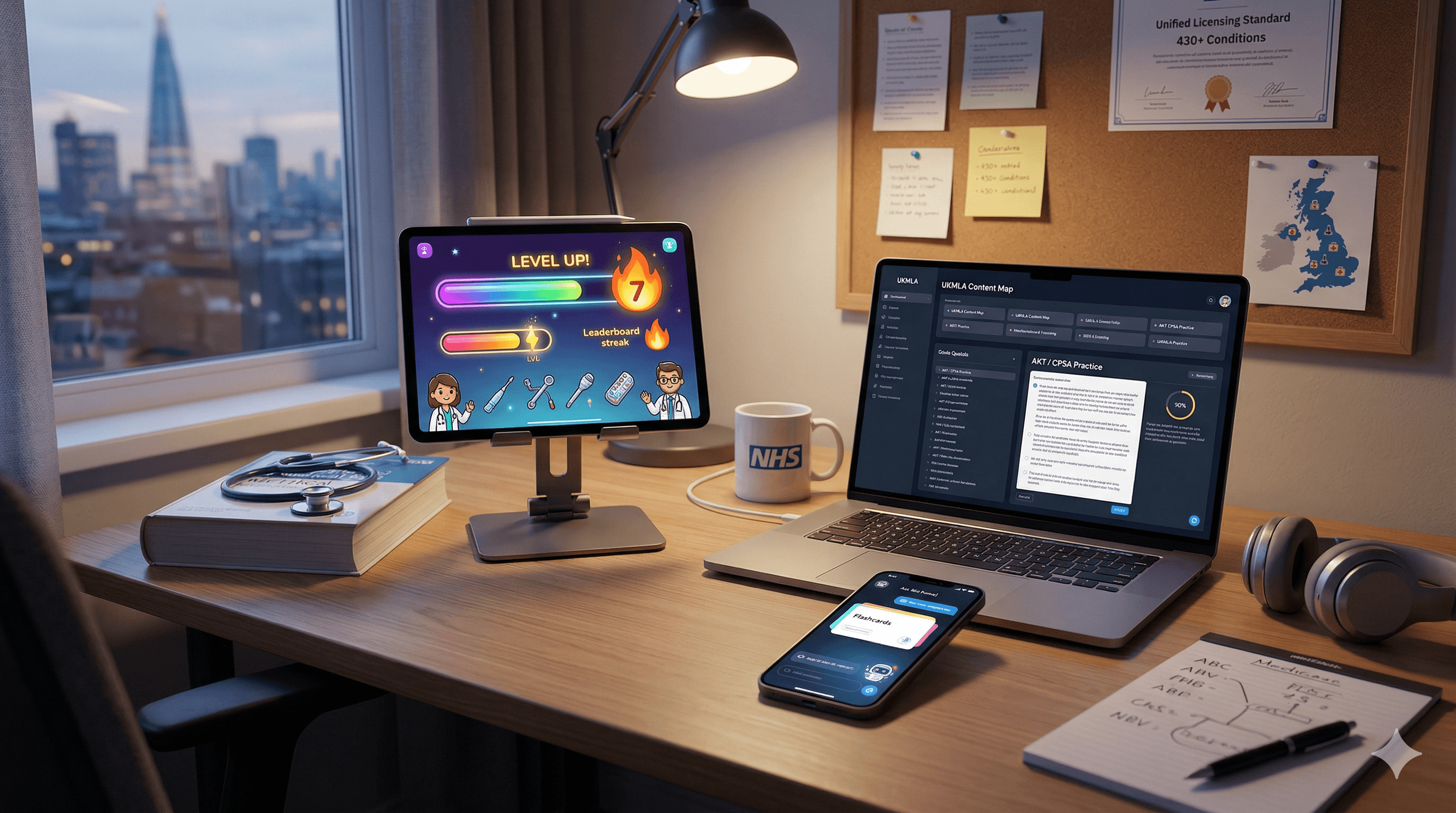
The UKMLA is now the unified licensing standard for all UK medical graduates and, via the aligned PLAB pathway, for international medical graduates. The 2026 content map update expanded the examinable conditions from 311 to 430, with new emphasis on clinical reasoning over factual recall. Choosing the right Q-bank matters more than ever — and the options now range from classic exam banks to AI-powered gamified platforms.
MedSnapp: Gamified Active Recall
MedSnapp is culturally different from every other medical Q-bank. It markets itself with streaks, XP, leaderboards, head-to-head battles, and daily challenges — the language of gaming applied to medical revision. It also offers PDF-to-question generation: upload your lecture notes and the AI converts them into questions, summaries, and quizzes.
The UKMLA-style questions cover clinical decision-making with progress tracking across specialties. The platform spans preclinical and clinical years.
Best for: Students who respond to gamification — daily streaks maintaining consistency, leaderboard competition providing motivation, and social features creating accountability.
MediWord
MediWord brings its recall-based approach to the UKMLA alongside its MSRA focus. Questions are NICE/GMC-aligned with detailed explanations linking to primary guidelines. The AI chatbot provides instant clarification.
Best for: Candidates who want exam-realistic questions with strong guideline linking and structured ethical reasoning.
Quesmed
Quesmed is the all-in-one platform: Q-bank, OSCE mark schemes, doctor-written notes, and video courses integrated into a single subscription. Its question curriculum matches the UKMLA content map covering all 311 conditions and 212 presentations (pre-2026 update). Twelve curated UKMLA mocks and five PSA mock tests replicate exam format and structure. Over 50 university-specific mocks are available for early-year students.
Best for: Students who want a single platform covering AKT, CPSA/OSCE, PSA, and knowledge notes without switching between tools.
PassMedicine
PassMedicine offers over 11,000 SBA questions for finals and UKMLA with a high-yield textbook, OSCE resource, and PSA preparation. Fifteen-plus years of exam data inform the question quality. Real-time peer comparison shows how you rank against current candidates.
Best for: Candidates who want maximum volume, proven reliability, and peer benchmarking from the most established UK medical Q-bank.
iatroX
iatroX provides an adaptive Q-Bank mapped to the UKMLA content map with spaced repetition algorithms that target your weaknesses. Unlike the other platforms, it integrates the Q-Bank with clinical reference: Ask iatroX provides NICE/CKS/emc-grounded answers when you need clarification, and Brainstorm supports structured clinical reasoning practice.
The entire platform is free — no subscription, no trial period, no paywall.
Best for: Students who want adaptive, evidence-based learning with integrated guideline clarification. Ideal as a complement to a primary Q-bank, adding the spaced repetition and guideline layer that static banks lack.
The Recommended UKMLA Stack
Primary Q-bank: Quesmed (all-in-one including OSCE) or PassMedicine (maximum volume). One comprehensive paid platform.
Adaptive layer: iatroX Q-Bank for daily spaced repetition targeting your weakest areas. Free.
Guideline clarification: Ask iatroX for instant NICE/CKS verification. Free.
Motivation and consistency: MedSnapp for gamified daily practice if you respond to streaks and social features.
Mock exams: At least 6-8 full UKMLA mocks from your primary bank. Exam simulation is non-negotiable.
Conclusion
The UKMLA Q-bank market in 2026 is diverse — from gamified platforms to recall banks to all-in-one suites. The strongest preparation combines a comprehensive primary bank, an adaptive spaced-repetition layer, and guideline-grounded clarification. iatroX provides the latter two for free.