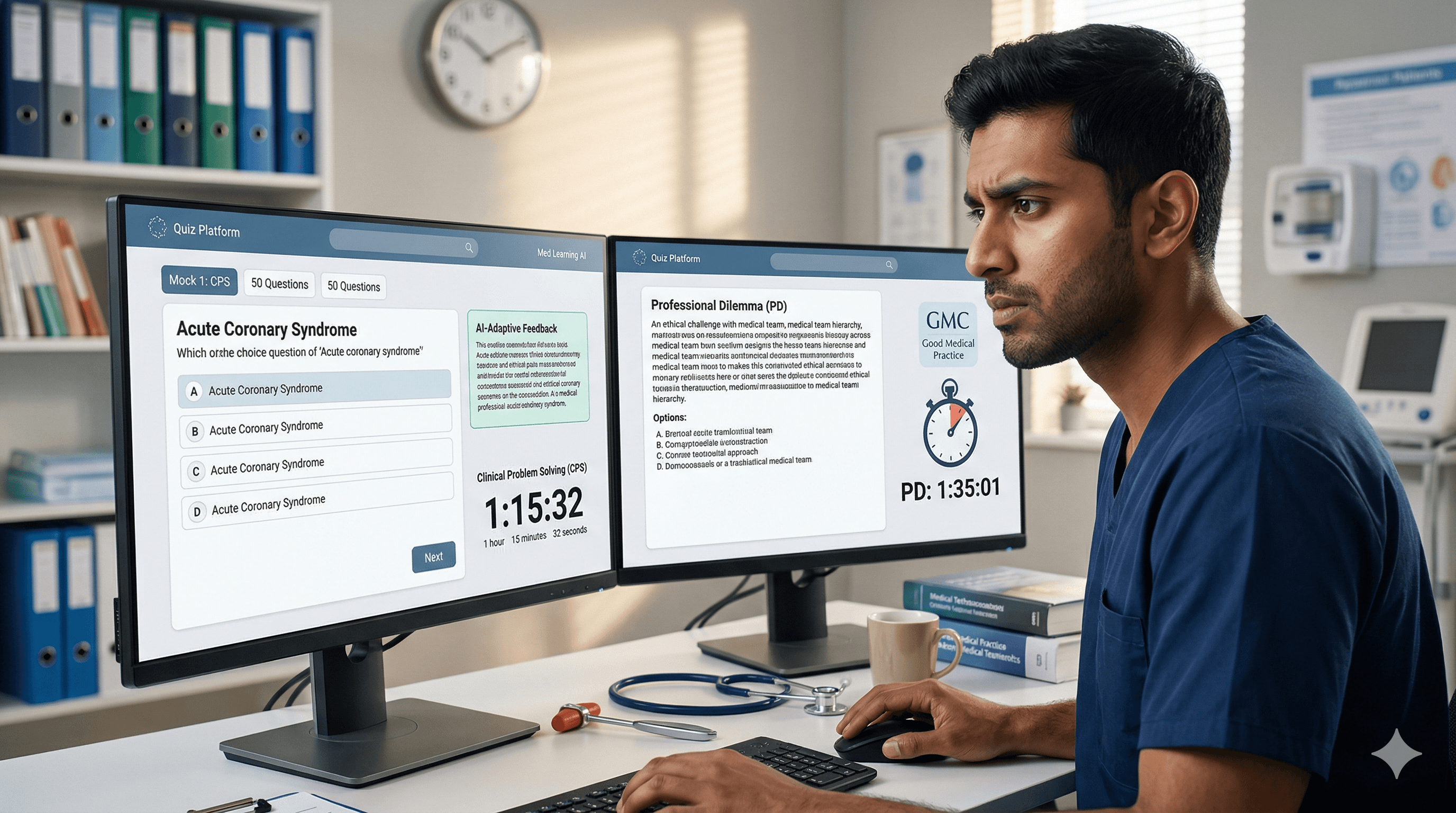
The MSRA is the single highest-stakes exam in UK specialty recruitment. For GP, Psychiatry, Radiology, CST, and ACCS applicants, your MSRA score often determines your training post — without an interview. GP ST1 and Psychiatry CT1 rank candidates solely on MSRA performance. A top score opens doors. A mediocre one closes them for a year.
The exam has two sections: Clinical Problem Solving (97 questions, 75 minutes) and Professional Dilemmas (50 scenarios, 95 minutes). Both are timed, pressured, and test pattern recognition, clinical reasoning, and professional judgement under conditions designed to separate candidates who know the material cold from those who know it loosely.
AI-powered question banks are now the primary preparation tool. Here are the ones worth knowing about.
MediWord
MediWord is the most MSRA-specific platform on the market. Built by doctors who scored in the top decile, it offers over 3,300 recall-based CPS questions, 630+ Professional Dilemma scenarios, full mock papers, flashcards, and revision notes — all mapped to real MSRA trends and current NICE/GMC guidelines.
The recall-based approach is MediWord's defining feature. Questions are modelled on patterns from recent exams rather than written de novo. Every clinical explanation references NICE or SmPC guidelines with direct links. The PD section uses a proprietary SMART framework for structured ethical reasoning aligned to GMC Good Medical Practice.
Pricing is competitive (circa £5.95/month). The platform includes an AI chatbot for instant explanations, a Telegram community, and regular webinars.
Strongest for: Candidates who want maximum exam realism through recall-based questions and dedicated PD preparation with structured ethical reasoning.
Medset
Medset positions itself as an AI-adaptive MSRA question bank, adjusting question difficulty and topic selection based on your performance. The adaptive engine targets your weakest areas automatically, reducing time spent on topics you already know.
Strongest for: Candidates who want AI-driven personalisation to maximise efficiency in limited revision time.
PassMedicine
PassMedicine is the established incumbent with over 15 years of MSRA data. It offers 2,900+ CPS questions, 300+ PD questions, three full mock exams with peer comparison, and extensive teaching notes that build into a reference library. The performance analytics compare your scores to other current candidates in real time.
PassMedicine's strength is volume, reliability, and community benchmarking. Its weakness, relative to newer platforms, is that its adaptive features are less sophisticated than AI-native tools.
Strongest for: Candidates who want a proven, high-volume question bank with peer comparison and extensive teaching notes.
iatroX
iatroX brings a different architecture to MSRA preparation. Its Q-Bank uses adaptive algorithms with spaced repetition — the evidence-based method where incorrectly answered questions resurface at optimal intervals to build durable knowledge. The platform maps to multiple UK exam curricula including MSRA-relevant content.
Beyond questions, iatroX adds layers that pure Q-banks do not: Ask iatroX provides instant, citation-first guideline clarification when you get a question wrong and need to understand the NICE recommendation. Brainstorm supports structured clinical reasoning for complex scenarios. The CPD module turns revision into documented professional development.
And it is free. No subscription, no trial period, no paywall.
Strongest for: Candidates who want adaptive spaced repetition with integrated guideline clarification — and who want to complement a primary Q-bank with a free, AI-powered weakness-targeting layer.
The Recommended MSRA Stack
Primary Q-bank: MediWord (for recall realism and PD depth) or PassMedicine (for volume and peer comparison). One paid primary bank is essential.
Adaptive layer: iatroX Q-Bank as the daily spaced-repetition engine that targets your weaknesses. Free.
Guideline clarification: Ask iatroX for instant NICE/SmPC/academiaverification when explanations are unclear. Free.
Mock exams: At least 3-4 full timed mocks from your primary bank. Simulate exam conditions including timing pressure.
PD-specific practice: MediWord's SMART framework or a dedicated PD resource. This section is 50% of your score and most under-prepared for.
Conclusion
The MSRA rewards candidates who combine exam-realistic practice with adaptive weakness targeting and guideline-grounded understanding. No single tool does all three perfectly. Build a stack: one primary Q-bank for volume and realism, iatroX for adaptive learning and guideline clarification, and dedicated PD preparation that treats professional dilemmas as a clinical skill, not an afterthought.