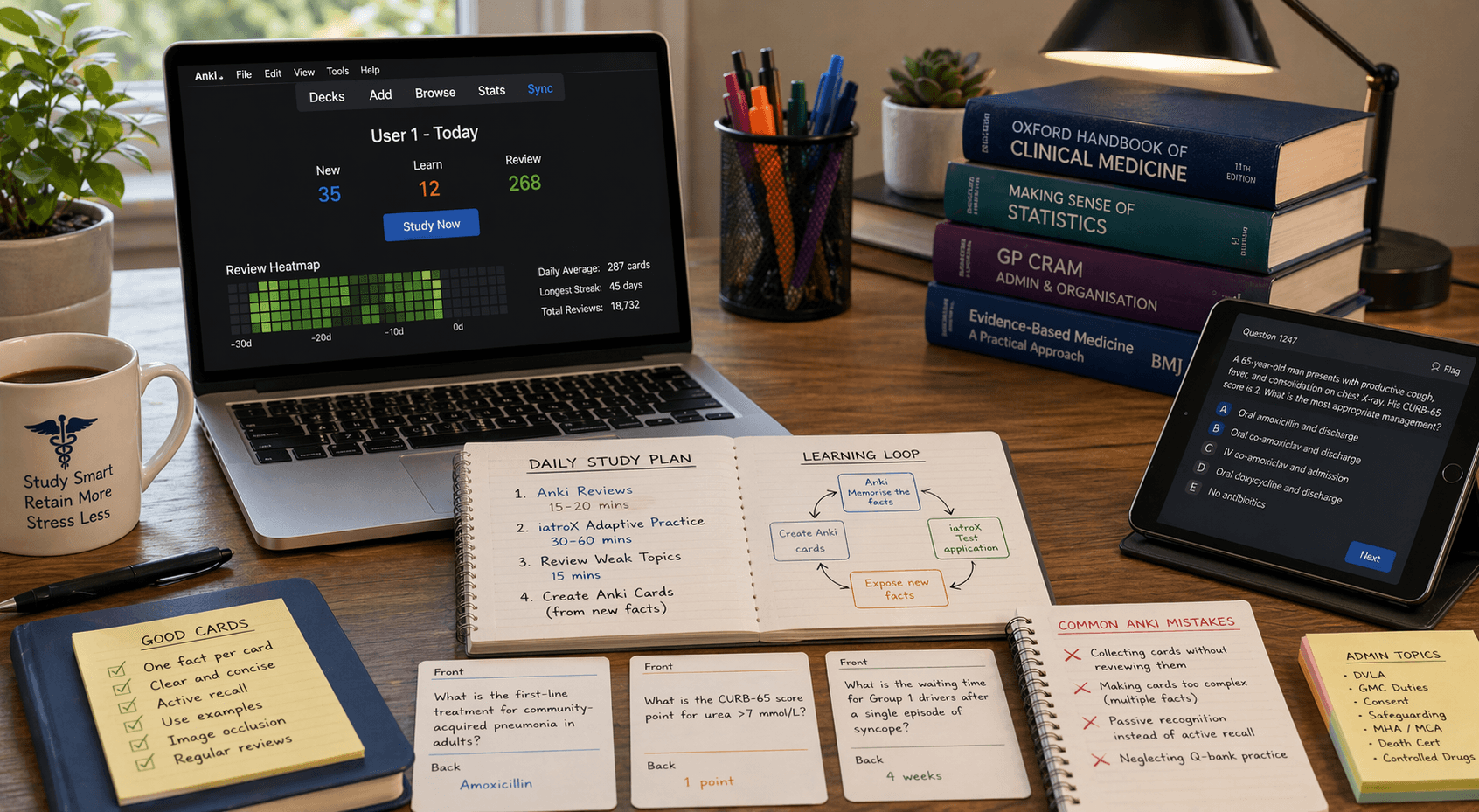
Anki is the most widely used spaced repetition tool in medical education worldwide. Its algorithm — based on the SM-2 spaced repetition algorithm — schedules card reviews at intervals optimised for long-term memory retention. If you get a card right, it appears again in a few days. If you get it right again, a few weeks. Then months. If you get it wrong, it resets to the beginning.
The result is efficient memorisation: you spend time reviewing the material you are about to forget, not the material you already know. For medical exams — where the volume of facts is enormous — this efficiency is transformative.
This guide covers how to use Anki effectively for UK medical exams, which decks to use, how to configure the settings, and how Anki relates to Q-bank practice.
Anki vs Q-Banks: Different Tools for Different Learning Modes
Anki and Q-banks serve different cognitive functions, and understanding the distinction is essential for using both effectively.
Anki tests recall — "what is the first-line treatment for community-acquired pneumonia?" The card has a simple answer (amoxicillin). You either know it or you do not. Anki excels at cementing discrete facts: drug doses, diagnostic criteria, classification systems, investigation sequences, and management protocols.
Q-banks test application — "a 65-year-old man presents with productive cough, fever, and consolidation on chest X-ray. His CURB-65 score is 2. What is the most appropriate management?" The answer requires integrating multiple facts (diagnosis, severity assessment, treatment guideline) and applying them to a clinical scenario.
The optimal approach uses both. Anki for memorisation, Q-bank for application. First learn the facts with Anki, then test your ability to apply them with a Q-bank like iatroX.
The Best Medical Anki Decks for UK Exams
Spranki — UKMLA
Spranki is a free, community-created Anki deck built specifically for the UKMLA. It targets the MLA Content Map and provides a ready-made set of cards for UK medical students preparing for the AKT component. Download and start immediately — no setup required.
Spranki is the fastest way to get a UKMLA-aligned Anki deck running. Its limitation is that it is community-maintained, so quality and completeness may vary across topics.
AnKing — Adapted for UK Use
The AnKing deck is the dominant medical Anki deck globally, originally built for USMLE preparation. It is comprehensive, well-maintained, and heavily tagged for topic filtering. UK medical students can use AnKing by filtering for relevant tags, though some content will be US-specific (drug names, screening guidelines, US-centric management).
AnKing requires more setup than Spranki but is more comprehensive.
Self-Made Cards
Many students build their own Anki cards from Q-bank explanations and lecture notes. The act of creating cards is itself a learning activity. The limitation is time — card creation is time-consuming and can become procrastination disguised as productivity.
A practical approach: make your own cards only for material that your pre-made deck does not cover, or for concepts you find particularly difficult.
Optimal Anki Settings for Exam Preparation
The default Anki settings are designed for general-purpose learning. For exam preparation, several adjustments improve efficiency.
New cards per day: 20–40 for long-term preparation (3+ months before exam), increasing to 40–60 in the final weeks. Avoid adding too many new cards per day — the review backlog will become unmanageable.
Maximum reviews per day: set to 9999 (unlimited). Never limit your daily reviews — the entire point of Anki is that the algorithm schedules reviews at optimal intervals. Capping reviews defeats the system.
Learning steps: 1 minute, 10 minutes (default). Some students add a third step (1 day) before cards graduate to the review queue.
Graduating interval: 1 day (default is fine).
Easy interval: 4 days.
Maximum interval: 180 days for exam preparation (the default of 36,500 days is designed for lifelong learning, not exam prep). You want cards reviewed within your exam preparation window.
How Anki Complements iatroX
iatroX has built-in spaced repetition — but it applies to exam-style SBA questions, not flashcards. The iatroX spaced repetition mode resurfaces questions you previously answered incorrectly at optimal intervals, testing your ability to apply knowledge in clinical scenarios.
Anki tests raw recall. iatroX tests application. Together, they cover both cognitive modes.
A practical daily workflow: start with 15–20 minutes of Anki reviews (maintaining your card reviews). Then do 30–60 minutes of iatroX adaptive practice (applying knowledge in exam-style questions). When you encounter a new fact in an iatroX explanation that you want to memorise, create an Anki card for it.
This creates a learning loop: Anki memorises the facts → iatroX tests the application → iatroX exposes new facts → Anki memorises those → cycle repeats.
Common Anki Mistakes
Collecting cards without reviewing them. Downloading a 20,000-card deck and adding 100 new cards per day leads to a review backlog that becomes impossible to maintain. Start small.
Making cards too complex. Each card should test one fact. "List the diagnostic criteria for rheumatoid arthritis" is a bad card. "What is the minimum number of joints required for RA classification (2010 ACR/EULAR criteria)?" is a good card.
Passive recognition instead of active recall. Seeing the answer and thinking "yes, I knew that" is not the same as producing the answer from memory. Be honest with yourself when rating card difficulty.
Neglecting Q-bank practice. Anki alone does not prepare you for medical exams. SBA questions test clinical reasoning, not recall. You need both.