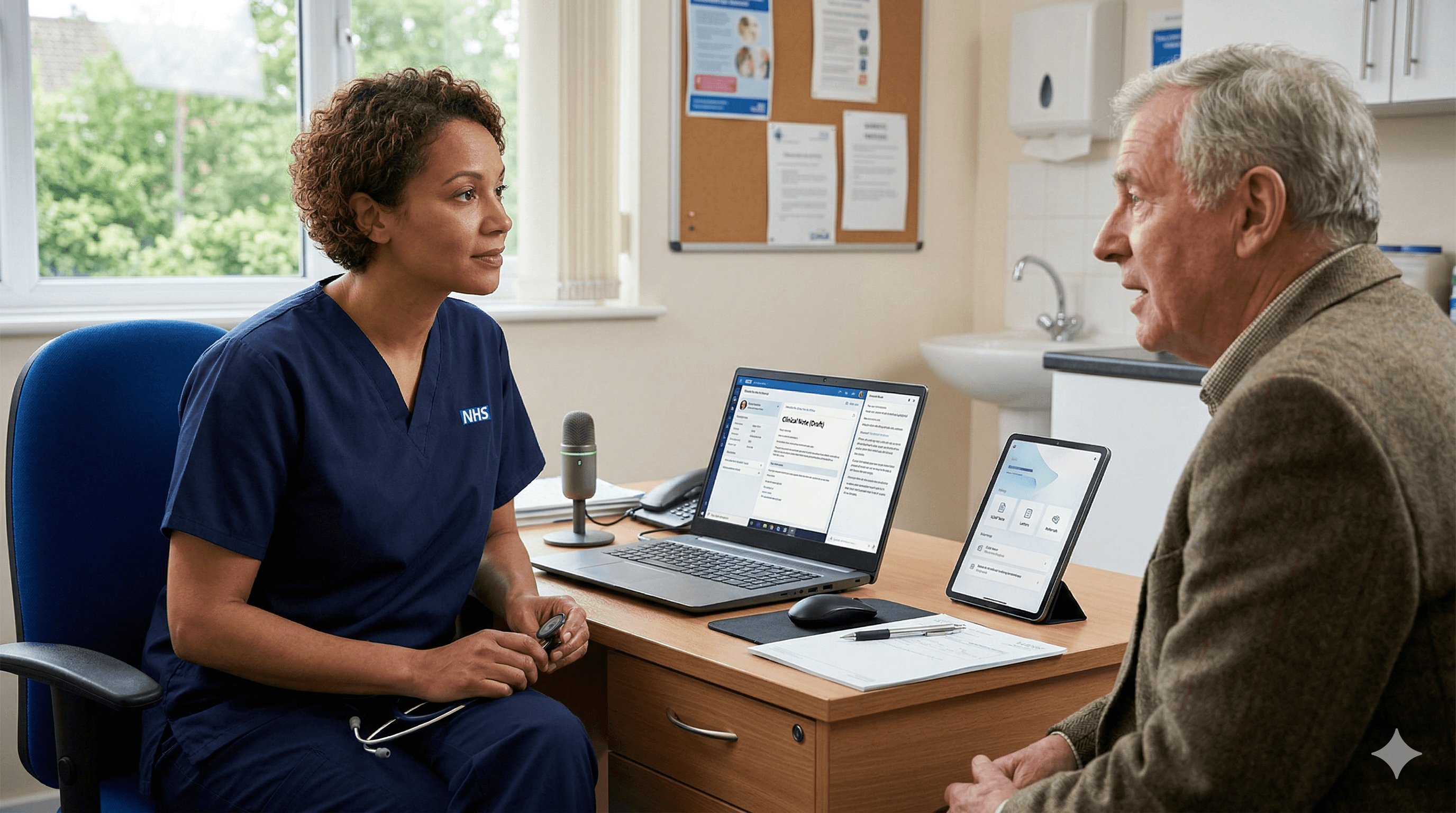
AI ambient scribes — tools that listen to patient consultations and generate structured clinical notes — have moved from early adoption to mainstream consideration in UK general practice. NHS England published its ambient voice technology (AVT) registry in January 2026, listing 19 suppliers that have self-certified compliance with clinical safety, data protection, and technology standards. The government's neighbourhood health framework includes a pledge to roll out AI and AVT across primary care.
The technology is real. The clinical time savings are evidenced. But the procurement landscape is confusing — and the governance requirements are non-negotiable.
What AI Scribes Do
An AI scribe passively listens to a patient consultation (face-to-face or telephone), transcribes the audio, generates a structured clinical summary (typically in SOAP or clinical coding format), suggests SNOMED/Read codes, and drafts referral or patient letters. The clinician reviews, edits, and approves the output before it is saved to the electronic health record. The key principle: the scribe generates a draft. The clinician makes the decision. AI never writes directly into the EHR without clinician approval.
Evidence from NHS evaluations suggests time savings of approximately 3-4 minutes per consultation — translating to 30-60 minutes per clinical session. A multi-site evaluation led by Great Ormond Street Hospital (published September 2025) involving 17,000+ patients found the technology provided "transformative" benefits, with potential to unlock £834 million annually if rolled out nationally.
The Current Market
Tortus AI. UK-developed. MHRA-registered as a Class I medical device (Class IIa pending). DTAC-compliant. Piloted across 9+ NHS sites. Integrates with EMIS, SystmOne. Strong governance credentials. Designed specifically for NHS workflows.
Heidi Health. Australian-origin with UK NHS compliance. Data hosted in UK. DTAC and DCB0129 aligned. Clinician-in-the-loop model. Active across UK general practice. Independent penetration testing. No data used for model retraining.
Accurx Scribe (powered by Tandem Health). Integrated into the Accurx platform (used by ~98% of GP practices for patient communications). 97% clinical accuracy rate in independent audits. 35-40% efficiency gains per session reported. Natural extension for practices already using Accurx.
Other registered suppliers: 33n, Anathem, Aprobrium (Lexacom), Beamup, Corti, Dictate IT, eConsult, HealthOrbit AI, Lyrebird Health, Microsoft Dragon, Optum (EMIS), Pungo (Joy), Scribetech, T-Pro. All listed on the NHS AVT registry.
DTAC Compliance: What to Check
The Digital Technology Assessment Criteria (DTAC) is the mandatory baseline for any digital health technology deployed in the NHS. It covers clinical safety (DCB0129 for manufacturers, DCB0160 for deploying organisations), data protection (GDPR, DSPT registration), technical security (Cyber Essentials Plus or equivalent), interoperability, and usability.
Before procurement, confirm: The supplier is listed on the NHS AVT registry. They have a published clinical safety case (DCB0129). They have a current DSPT registration. A Data Processing Agreement (DPA) is in place. No patient data is used for model retraining without explicit, specific consent. Data is hosted in UK data centres with encryption in transit (TLS 1.2+) and at rest (AES-256).
Data Governance
Where the audio goes: Responsible suppliers process audio in real-time, generate the note, and delete the audio after processing. No audio should be stored beyond the processing window. Confirm this with your supplier. GDPR: Patient consent is required — either verbal (documented in the note) or via practice-level privacy notice. Current best practice: verbal consent script at the start of each consultation. Model training: Confirm that no patient data from your consultations is used to train or improve the AI model. This is a red line for NHS information governance.
Cost-Benefit
Typical pricing: £150-500/month per clinician depending on supplier and contract terms. At 4 minutes saved per consultation across 30 consultations per day, that is 2 hours per day per clinician returned to clinical care or personal time. The cost-benefit depends on what you do with the saved time — if it enables an additional 4-6 patients per day, the financial return exceeds the subscription cost.
EHR Integration
EMIS: Tortus, Accurx Scribe, and several others integrate directly. SystmOne: Integration varies — check with individual suppliers. Vision: Limited integration currently — some suppliers offer copy-paste workflow rather than direct integration.
How AI Scribes Complement Clinical AI
AI scribes handle documentation — what was said and done. Clinical decision support tools like iatroX handle decision-making — what should be done next. The two are complementary. A scribe generates the consultation note. Ask iatroX answers the clinical question that arose during the consultation. iatroX Calculators provides the clinical score that informed the management decision. Together, they represent the clinical AI stack: scribes for efficiency, decision support for accuracy.