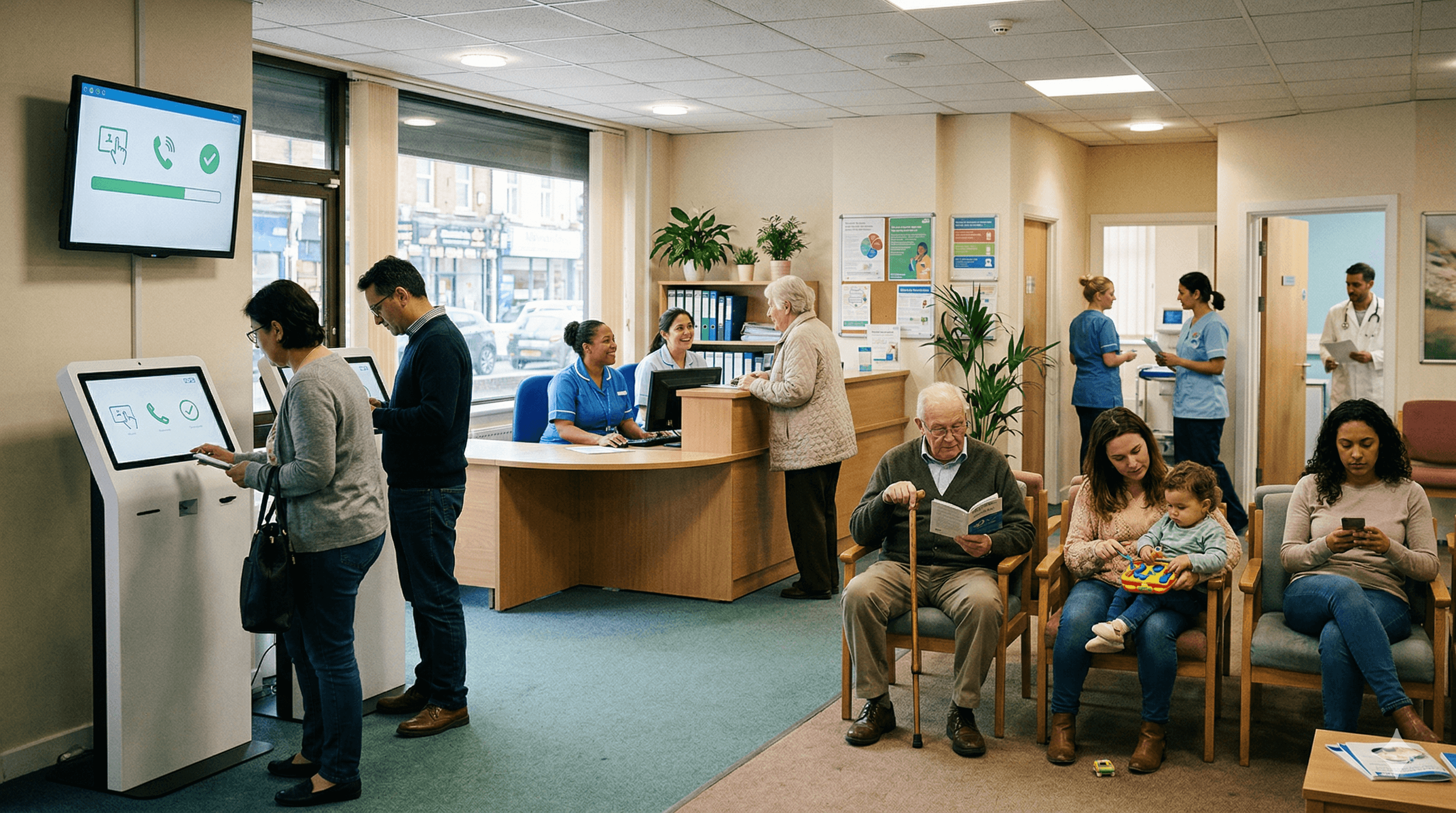
General practice needs better access. Patients are tired of queueing and confusion. Vendors promise smoother, faster, more modern ways in. And practices, under enormous workforce pressure and policy expectation, are understandably attracted to tools that seem to solve the most visible problem they face.
But the NHS has a long institutional memory of access "solutions" that looked modern and sounded promising but, in practice, merely redistributed friction. Choose-and-book. Extended-hours schemes that generated new demand without resolving existing backlogs. Online consultation tools that were technically available but practically unused because patients were never told about them or could not navigate them.
The question for AI receptionists is not whether the technology can answer a phone call. It clearly can. The question is whether answering the call faster actually improves the patient's journey — or whether it simply automates the first frustration in a sequence of frustrations that remains unchanged.
This article takes the category seriously. AI receptionists can be genuine help. But they can also become what might be called triage theatre: a visible modernisation that looks like progress from the outside but changes nothing meaningful about how patients actually get care.
What Genuine Help Would Look Like
If an AI receptionist is genuinely helping, the following things should be measurably true.
Fewer patients abandon their attempt to contact the practice. This means fewer calls dropped, fewer people giving up, fewer repeat call attempts.
Queue times are meaningfully shorter. Not just at 8:01am, but across the morning and throughout the day.
Routine administrative tasks — prescription requests, appointment queries, fit note submissions — are completed faster, with fewer touches and less staff involvement per transaction.
Non-urgent requests are routed more accurately, so that clinical triage capacity is reserved for genuinely clinical questions rather than admin that could have been handled without a clinician.
Reception staff are freed for higher-value work. They spend more time supporting patients face to face, navigating complex queries, handling vulnerable callers, and less time answering identical phone calls in sequence.
Patients understand what happens next. After speaking to the AI, they know whether they will be called back, given an appointment, or directed elsewhere — and they trust that information.
These are measurable outcomes. If a practice cannot demonstrate improvement in at least some of them after six months of using an AI receptionist, the tool is not delivering genuine help, regardless of how many calls it technically answers.
What Triage Theatre Looks Like
Triage theatre is the opposite: visible activity that resembles improvement but does not change the patient's experience or the practice's operational reality.
The AI answers instantly — but then sends the patient into the same slow queue they would have joined anyway, just with a form attached instead of a phone hold.
Patients end up repeating themselves across multiple channels. They speak to the AI, then get a callback from a receptionist who asks the same questions, then speak to a clinician who starts from scratch.
Everything becomes a triage form regardless of need. A patient who wants to know when their blood results are ready gets the same structured intake process as a patient with a new lump. The system treats every interaction as clinical triage even when the patient just has a question.
Urgent concerns are handled with generic scripts. A patient who describes worrying symptoms receives a polite acknowledgement and a promise that someone will be in touch, without any real-time escalation or safety-netting.
There is no meaningful human override. The patient who says "I need to speak to a person" is redirected back into the AI flow, or given a callback window that is no faster than the old phone queue.
The practice can report that 100% of calls are answered in under ten seconds. But patient satisfaction has not improved, complaints have not reduced, and the reception team feels busier than before because they are now managing exceptions from a system that was supposed to reduce their workload.
That is triage theatre. It is modernisation as performance rather than modernisation as improvement.
Why Practices Are Tempted by the Category
None of this means practices are wrong to be interested. The forces driving adoption are real and legitimate.
Workforce pressure is acute. Reception teams are understaffed, undertrained relative to the complexity of their role, and often subjected to unacceptable behaviour from frustrated patients. Any tool that absorbs some of that pressure is immediately attractive.
Peak-time telephone demand is genuinely overwhelming in many practices. Hundreds of calls in the first hour of the day, many of them for routine tasks that do not require human handling, create a bottleneck that degrades the experience for everyone — including the patients with urgent needs who cannot get through.
Practices need better reporting and standardisation. An AI receptionist that logs every interaction in a structured format provides data that a ringing phone line does not.
And policy pressure is real. NHS England's access modernisation agenda, the requirement to keep online consultation tools available, and CQC's focus on access quality all create an environment where standing still feels riskier than moving forward.
The Case for AI Receptionists
The strongest arguments are practical, not theoretical.
Always-on answering means no patient is met with an engaged tone or a message saying the practice is closed to calls. For patients who have spent years being unable to get through, the simple act of being answered is significant.
Consistency is an underrated benefit. A well-configured AI receptionist asks the same questions in the same order every time. It does not have bad days, forget to ask about allergies, or accidentally give the wrong information because it was distracted by another call.
Multilingual capability at scale is something no practice can replicate with human staffing alone. In diverse populations, the ability to interact in a patient's first language — even for a routine administrative task — can meaningfully reduce barriers.
Structured demand capture converts unstructured phone calls into reviewable, triageable requests. This is operationally powerful because it gives the clinical team something they can work through systematically rather than reactively.
Tools like QuantumLoop EMMA, InTouchNow, and adjacent platforms are building real products around these benefits, with NHS-specific positioning and emerging practice-level deployment evidence.
The Case Against
The strongest objections are equally practical.
Exclusion of vulnerable patients is the most serious concern. People who are anxious, frail, confused, hearing-impaired, living with dementia, in emotional distress, or simply uncomfortable with automated systems may find an AI receptionist a barrier rather than a bridge. If a practice's most vulnerable patients are the ones most disadvantaged by the new system, that is an equity failure.
Loss of relational nuance matters. An experienced receptionist who recognises a regular caller's voice, knows their history, and can detect distress from tone alone provides something an AI system cannot replicate. That relational layer is not a luxury — in general practice, it is part of the safety net.
Oversimplification of complex patient intent is a real risk. Patients do not always know what they need. They say "I want an appointment" when they actually need advice. They say "it's not urgent" when it is. They say "I'm fine" when they are not. AI systems that take stated intent at face value may route patients incorrectly.
Governance and complaint-handling burdens should not be underestimated. When a patient believes the AI gave them wrong information or failed to escalate their concern, the practice is accountable. That means a robust complaints process, clear audit trails, and staff who understand how to investigate AI-mediated interactions.
And the risk of metric gaming is real. A practice might report dramatically improved call-answering times while patient experience and clinical safety remain unchanged or even decline. The metric that matters is not calls answered — it is problems resolved.
The Test That Matters: Does It Improve the Patient Journey End to End?
The right evaluation framework for an AI receptionist is not technical. It is experiential.
Did the patient get to the right place? Not just "was the call answered?" but "did the request reach the right person, with the right information, in a reasonable timeframe?"
How many touches were required? If the patient spoke to the AI, then received a callback from a receptionist, then another callback from a clinician, the total contact burden may be higher than the old system, even if the first contact was faster.
Was the experience more or less stressful? Stress is not just about waiting time. It is about clarity, predictability, and the feeling of being heard.
Did staff actually gain time? Not in theory, but in practice. Are reception staff doing more valuable work, or are they spending their newly freed hours managing AI exceptions?
Were vulnerable patients protected? Not as an average across the population, but specifically — the confused elderly caller, the patient in crisis, the non-English speaker, the person who cannot articulate their need clearly.
A Practical Conclusion for Practices
AI receptionists can be genuine help. But only under certain conditions.
Pilot carefully. Run a time-limited trial with clear metrics defined in advance. Measure not just call-answering speed but patient experience, staff experience, escalation accuracy, and exception rates.
Communicate clearly. Tell patients what is changing, why, and what to expect. Provide alternatives. Do not assume that everyone will welcome the change.
Keep human fallback prominent and easy. One button press or one spoken phrase should connect a patient to a person. No exceptions.
Audit exceptions rigorously. The most important data from an AI receptionist pilot is not the calls it handled well — it is the calls it handled poorly. Learn from those.
Watch equality impacts. Monitor uptake and experience by age, language, disability, and deprivation. If the system works well for one demographic and poorly for another, that needs to be addressed before full rollout.
Redesign downstream workflow before praising or blaming the AI layer. An AI receptionist that feeds demand into a broken triage process will produce broken outcomes. Fix the process first.
Where Knowledge and Education Support Better Judgement
Behind every AI receptionist is a team of humans making decisions. Those humans need reliable clinical knowledge, fast.
iatroX serves this need directly. When a clinician is triaging a batch of AI-captured requests and needs to verify whether a symptom pattern warrants same-day review, the Ask iatroX feature provides guideline-grounded, citation-first answers in seconds. When a GP trainee is unsure how to interpret an AI-flagged escalation, iatroX's Brainstorm tool helps them reason through the scenario step by step. And when the practice wants to turn operational learning from the AI rollout into professional development, iatroX's CPD module provides a structured, reflective framework.
The AI receptionist handles the front door. The clinical team handles the judgement. Tools like iatroX support the judgement layer — which is, ultimately, the layer that determines whether the patient gets the right care.
Conclusion
AI receptionists are helpful when they remove steps. They become theatre when they simply automate the first frustration.
The category deserves serious attention. The access problem is real, the technology is maturing, and the operational case is credible. But genuine help requires more than faster answering. It requires better routing, safer escalation, honest communication, equitable access, and a downstream workflow that can actually deliver on the promise the front door makes.
Practices that implement AI receptionists as part of a broader service redesign — with governance, measurement, and patient-centred design at the core — will see real benefits. Practices that bolt an AI front door onto an unchanged system will get triage theatre. The technology is the same in both cases. The difference is the thinking behind it.