Tool facts
- Category: Patient-facing symptom assessment / care navigation.
- Outputs: Possible causes + guidance; explicitly not a diagnosis.
- Regulatory claim: Ada states it is a certified Class IIa medical device in the EU (Google Play).
- Best for: Structured symptom history, patient reassurance, and "what to do next" framing.
- Not for: Clinician decision-making without independent verification.
Introduction: what Ada is
Ada markets itself as a free symptom checker "built on AI and clinical evidence." It is one of the most widely used health apps globally, designed to help patients understand their symptoms.
The key boundary for any clinician to understand is this: Ada produces suggestions and guidance, but it explicitly states in its terms and user flow that it cannot give a medical diagnosis. It is a sophisticated triage and information tool, not a doctor (Google Play).
Why symptom checkers keep coming up in GP
Patients are increasingly performing "pre-consults" online before they walk through your door. They arrive with a list of potential conditions generated by an app. The task for the modern GP is not to dismiss this, but to translate that output into a safe, effective clinical consultation.
The UK clinician’s reality check: EU Class IIa ≠ UK assurance
It is crucial to understand the regulatory nuance. Ada holds an EU-MDR Class IIa certification. However, since Brexit, the UK has its own regulatory framework. While CE marks are currently accepted during the transition period, UK clinicians should look for tools that also align with UK-specific assurance, such as registration with the MHRA for the Great Britain market (GOV.UK).
What the evidence says about accuracy
This is where you can build trust with your patients by being honest about the technology. Large-scale evaluations, such as those published in BMJ Open, have consistently shown that symptom checkers have variable diagnostic accuracy.
- Triage Safety: They are often better at triage (advising when to see a doctor) than at diagnosis.
- Diagnostic Accuracy: In head-to-head comparisons, physicians still significantly outperform symptom checkers in listing the correct diagnosis first (top-1 accuracy) (BMJ Open).
- The Takeaway: Ada is useful for generating possibilities, but it is not a replacement for a clinical history and exam.
How to use Ada outputs safely in a GP consult
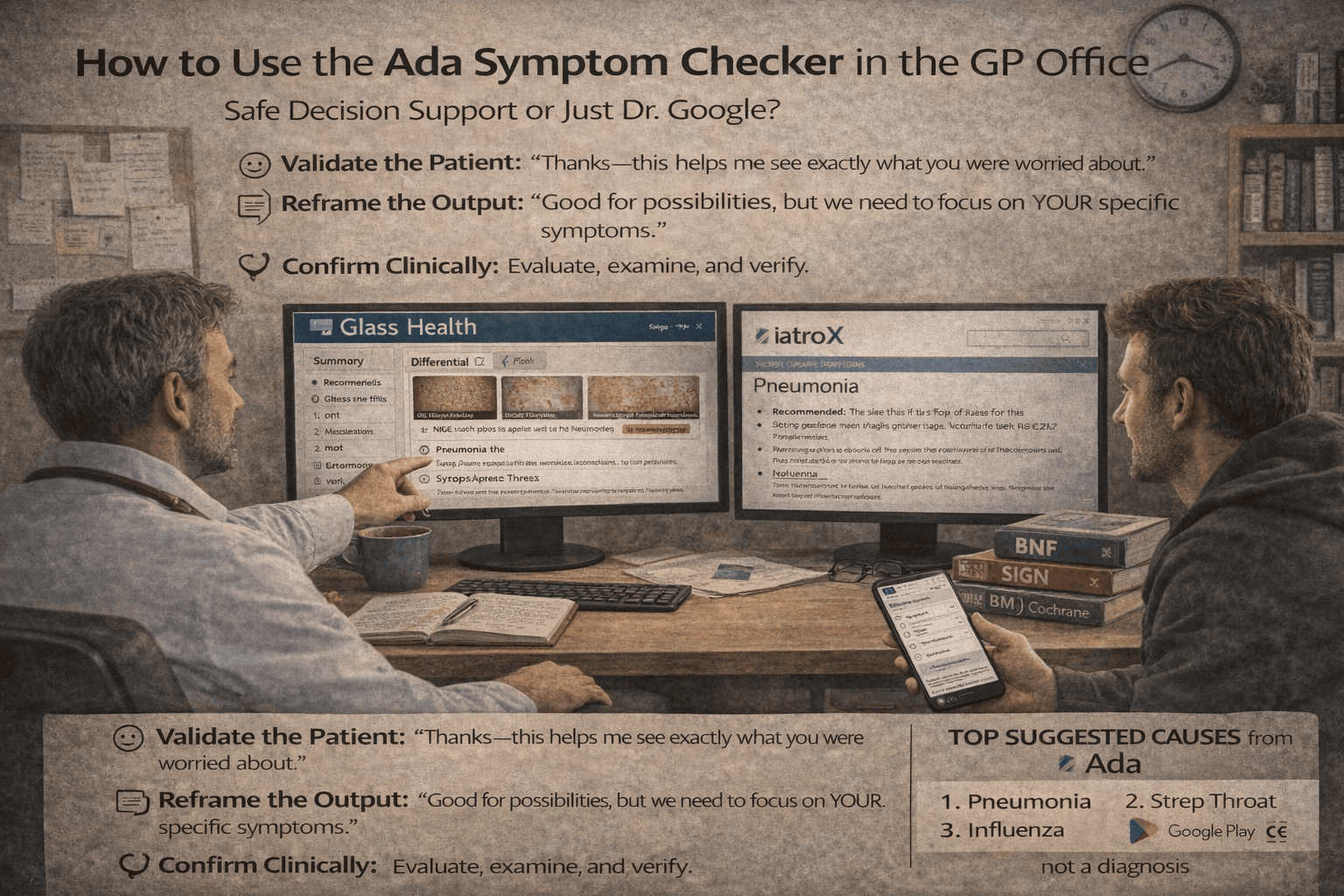
When a patient presents an Ada report, use this 5-step script:
- Validate: “Thanks — this helps me see exactly what you were worried about.”
- Reframe: “These tools are great for listing possibilities, but they can't diagnose you. Let's look at your specific situation.”
- Extract signal: Use the report to quickly identify their symptoms, duration, and any red flags they've already noted.
- Confirm clinically: Perform your own focused history and examination to rule in or out the suggestions.
- Safety-net: Provide a clear follow-up plan.
Failure modes to call out
- Anchoring: Both patients and doctors can get stuck on the first suggestion in the list.
- Context gaps: Apps often miss critical context like local disease prevalence, complex comorbidities, or pregnancy, which changes the differential completely.
- False reassurance: A patient might delay care because a serious condition wasn't in the app's top 3 suggestions.
Where iatroX fits (and why it’s different)
iatroX is a fundamentally different category of tool. It is clinician-facing, not patient-facing.
- Provenance: iatroX positions itself as a UKCA-marked and MHRA-registered Class I medical device for informational use (iatroX).
- Workflow:
- Ada helps the patient structure their symptoms.
- iatroX Ask helps the clinician verify the management plan with citation-first answers from NICE and CKS.
- iatroX Brainstorm helps the clinician structure their reasoning for the notes.
- iatroX Quiz turns that clinical uncertainty into a learning opportunity.
The Positioning: “Ada helps patients structure symptoms; iatroX helps clinicians verify and act with UK-relevant, cited information — and turn uncertainty into learning.”
FAQs
Is Ada a medical device in the UK? Ada is a certified Class IIa medical device under the EU MDR. For the UK market, devices must be registered with the MHRA.
Can Ada diagnose? No. Its own disclaimer states it provides an assessment, not a medical diagnosis.
How accurate are symptom checkers? Studies generally show they are less accurate than doctors, with variable performance depending on the condition and the specific app (BMJ Open).
What should I do when a patient brings an Ada report? Treat it as a detailed symptom diary. Use it to speed up your history taking, but do not rely on its diagnostic suggestions without your own verification.