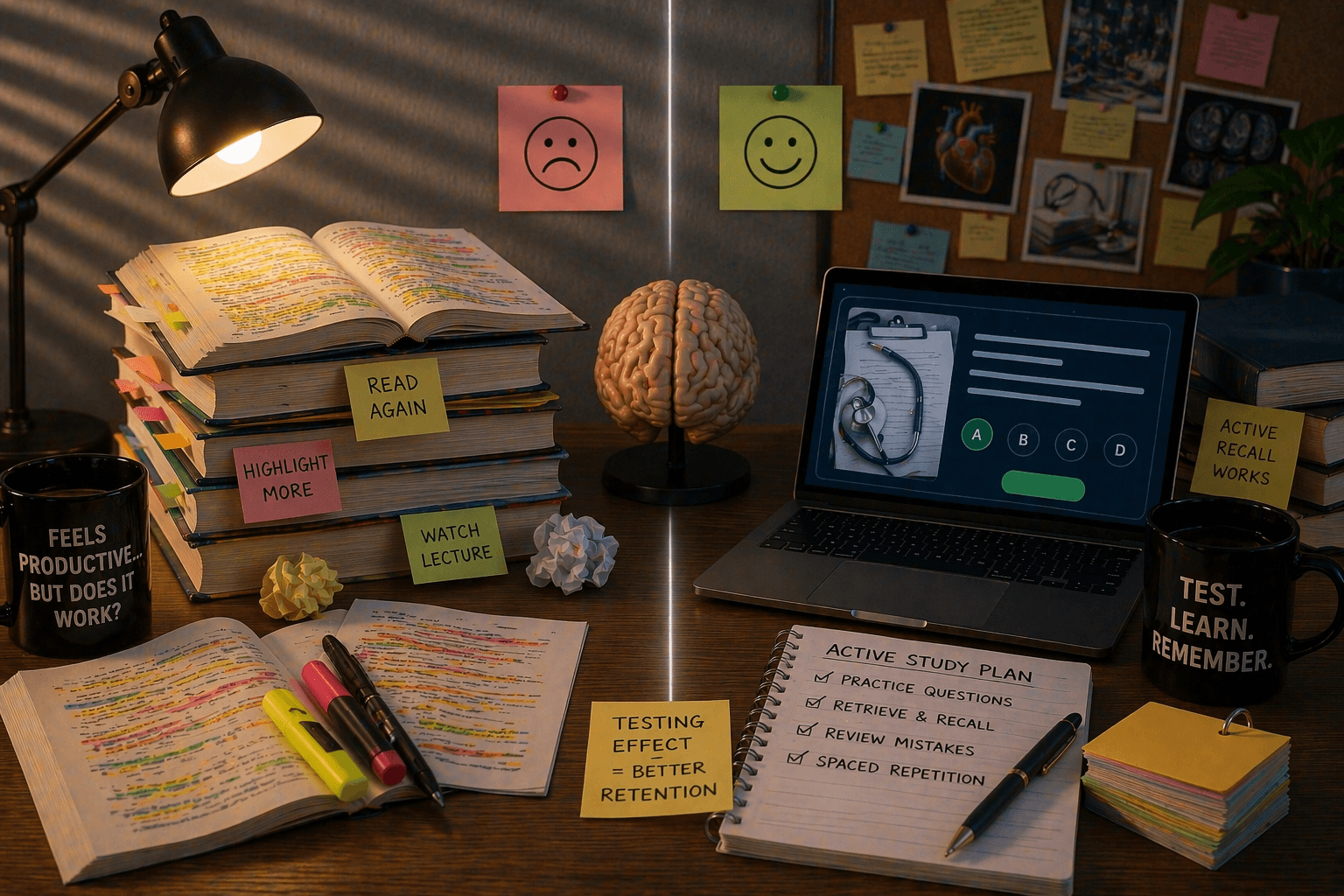
The most common medical student study method — reading notes, highlighting textbooks, rewatching lectures — is also the least effective for long-term retention. This is not opinion; it is the consistent finding of decades of educational psychology research.
The Testing Effect
Karpicke and Roediger (2008) conducted a landmark study: students who tested themselves on material retained approximately 50% more after one week than students who re-read the same material for an equal duration. The testing effect has been replicated across subjects, age groups, and testing formats. In medical education specifically, practice testing outperforms every other study technique.
Why Passive Methods Feel Effective
The fluency illusion explains why re-reading feels productive. When you re-read your lecture notes, the material feels familiar — you recognise the concepts, the drug names look right, the diagnostic criteria seem clear. This fluency creates an illusion of knowledge. But recognition is not recall. Being able to recognise an answer when you see it on the page is fundamentally different from generating it from memory under exam conditions with no cues.
The dangerous consequence: students who study by re-reading consistently overestimate their actual knowledge. They feel prepared because the material feels familiar. Then they sit the exam and discover that familiarity evaporates when you need to produce the answer, not just recognise it.
The Effectiveness Hierarchy
Practice testing (Q-banks, self-quizzing, teaching) > spaced flashcard retrieval (Anki) > summarising in your own words > re-reading > highlighting. Every study hour spent highlighting a textbook is a study hour that would have produced measurably better retention as Q-bank practice.
How to Implement
Make Q-bank practice your primary study activity — not supplementary reading after you have "finished" studying. Use questions to learn, not just to test what you have already learned. Review every wrong answer thoroughly — the testing effect is strongest when you discover and correct errors. This is the error-correction mechanism: the gap between what you thought you knew and what you actually know is where the deepest learning occurs.
iatroX is built around active recall. Every interaction is a retrieval exercise — a clinical vignette requiring you to generate an answer from memory. Not a video to watch. Not a page to read. A question to answer.