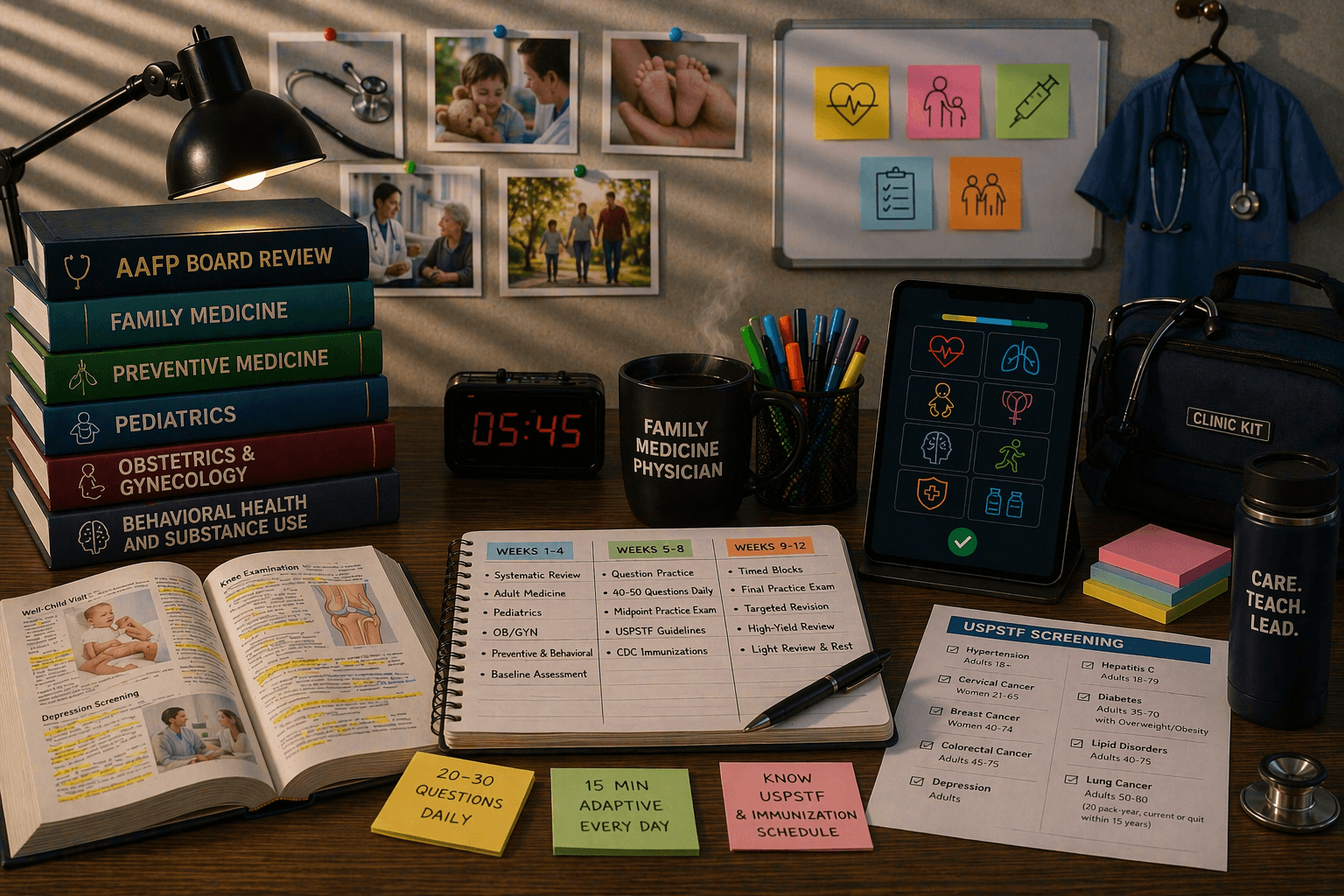
The ABFM certifying exam covers the full family medicine scope — approximately 300 questions in one day spanning paediatrics, OB/GYN, adult medicine, geriatrics, behavioural health, musculoskeletal, dermatology, preventive medicine, and practice management. The breadth is the challenge — no single topic dominates, so preparation requires systematic coverage.
Weeks 1-4 (Systematic Review)
Cover one major topic area per week: adult medicine (cardiology, pulm, GI, endocrine), paediatrics (well-child, developmental milestones, common conditions), OB/GYN (prenatal care, contraception, common gynaecological conditions), and preventive/behavioural health (USPSTF screening, mental health, substance use). Do 20-30 questions daily from your primary resource (AAFP Board Review or UWorld FM). Take a baseline practice assessment in week 1 to identify weak areas objectively. Run iatroX adaptive mode for 15 minutes daily — it targets your weak topics automatically from day one.
Weeks 5-8 (Question-Heavy)
Increase to 40-50 questions daily. Focus on weak areas identified in the first phase. Take a mid-point practice exam at the end of week 8. Add targeted review of USPSTF screening guidelines (directly tested — know grade A and B recommendations cold) and CDC immunisation schedule (paediatric and adult). These are free online and represent reliable exam points.
Weeks 9-12 (Performance)
Timed blocks simulating exam conditions. Final practice exam. Targeted revision of persistent weak areas using iatroX adaptive mode. High-yield final review: preventive medicine guidelines, paediatric milestones, behavioural health management, common MSK presentations, dermatology pattern recognition. Last week: light review, no new material, rest.
Daily Schedule for Residents
1 hour on workdays — before or after clinic (morning is highest quality). 3-4 hours on off days. iatroX mobile for 15-minute adaptive sessions during transitions. Commute: podcasts (AFP journal podcast, FMCases). The key is daily contact with the material, not marathon sessions.