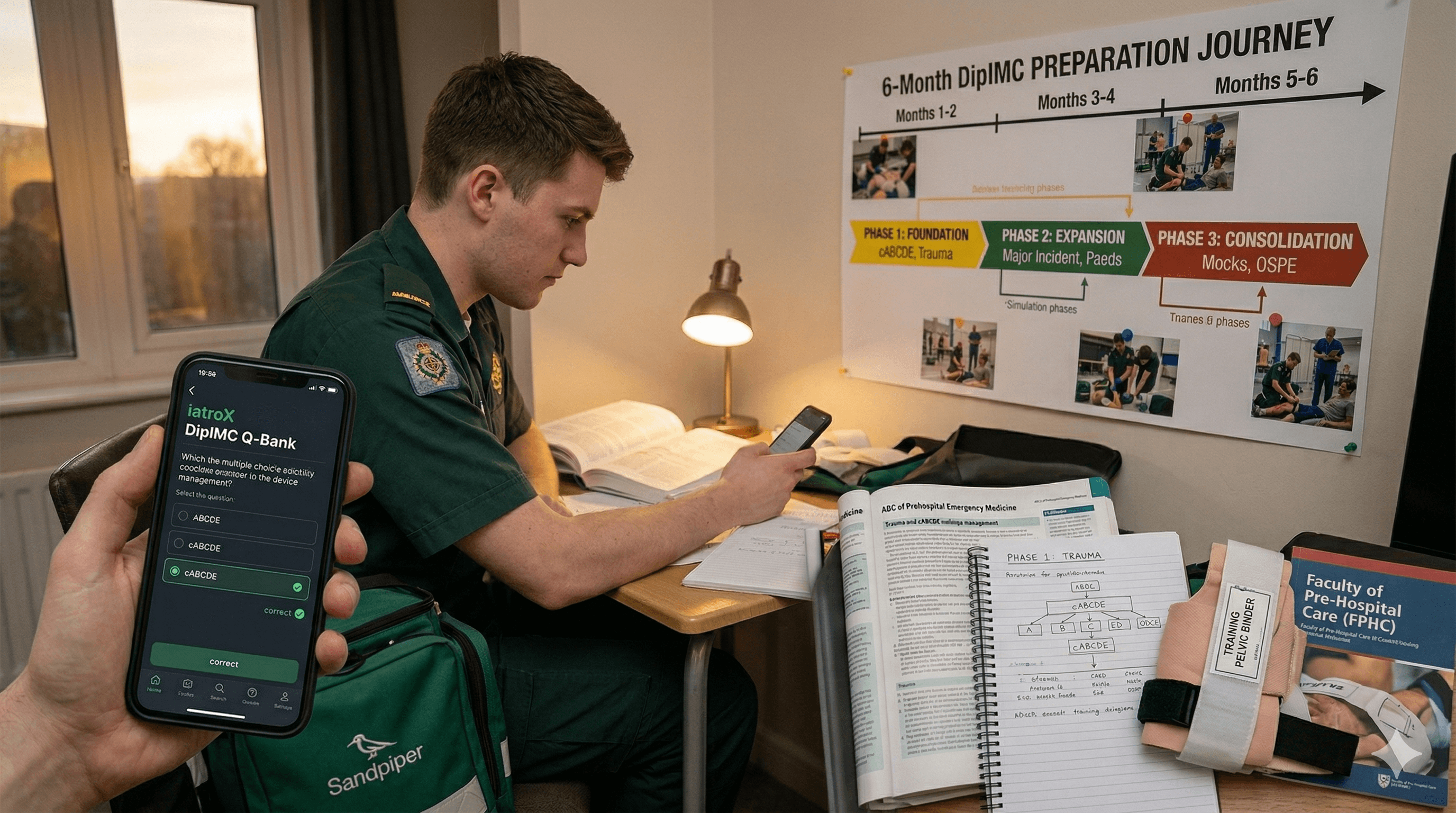
Six months is the optimal preparation period for the DipIMC — long enough to cover the breadth of the curriculum, short enough to maintain momentum. This plan assumes you are working clinically and studying part-time (2-3 hours on weekday evenings, 5-6 hours at weekends).
Phase 1: Foundation (Weeks 1-8)
Build the knowledge base across the core curriculum domains.
Weeks 1-2 — Trauma management. cABCDE, catastrophic haemorrhage, specific injuries (head, chest, abdomen, pelvis, spine, extremity), damage control resuscitation. Begin iatroX DipIMC Q-Bank at 20-25 questions daily from day one.
Weeks 3-4 — Medical emergencies. Cardiac arrest, ACS, stroke, anaphylaxis, seizures, asthma, DKA, poisoning, environmental emergencies. Continue daily Q-bank practice.
Weeks 5-6 — Pharmacology and airway. Drug mechanisms, doses, interactions for the pre-hospital formulary. Basic and advanced airway management, failed airway, RSI, front-of-neck access.
Weeks 7-8 — Paediatrics and obstetrics. Paediatric emergencies, age-specific physiology, newborn resuscitation. Obstetric emergencies, normal delivery, complications. Read relevant ABC textbook chapters.
Start OSPE practice with peers from week 6 onwards — initially informal scenario walkthroughs.
Phase 2: Expansion (Weeks 9-16)
Cover remaining topics and begin structured OSPE practice.
Weeks 9-10 — Major incidents. METHANE, CSCATTT, triage sieve, triage sort, NARU guidance, JESIP. Increase Q-bank to 30-40 questions daily.
Weeks 11-12 — Scene management, professional practice, applied physiology. Dynamic risk assessment, consent, capacity, safeguarding, communication, documentation. Shock physiology, respiratory physiology, thermoregulation.
Weeks 13-16 — OSPE-focused preparation. Structured OSPE practice sessions weekly with peers. Practise procedural skills (thoracostomy, cricothyroidotomy, tourniquet, pelvic binder, IO access). Practise communication stations (handover, breaking bad news, bystander management). Continue Q-bank daily.
Phase 3: Consolidation (Weeks 17-24)
Week 17: First full SBA mock exam (180 questions, 3 hours, timed). Analyse by topic. Identify weakest areas.
Weeks 18-20: Targeted weakness revision based on mock results and iatroX performance data. Use Ask iatroX for precision — verify every uncertain point against the UK guideline.
Weeks 21-22: Second and third mock exams. Intensive OSPE practice. Attend a DipIMC preparation course if available.
Week 23: Final mock. Review FPHC Faculty Statements. Light revision.
Week 24: Travel to Edinburgh. Rest. Exam.
Daily Routine
Commute/breaks: 10-15 iatroX questions on mobile.
Evening study (2-3 hours, 4-5 nights/week): 25-40 primary Q-bank questions + topic reading.
Weekend (5-6 hours one day, rest day the other): Longer study blocks, OSPE practice, mock exams.
The Resource Stack
Q-Bank: iatroX DipIMC Q-Bank — 700+ questions, adaptive, curriculum-mapped. Single subscription includes multiple Q-banks.
Textbook: ABC of Prehospital Emergency Medicine.
Guidelines: FPHC Faculty Statements, NARU guidance, Resuscitation Council UK guidelines.
Clinical reference: Ask iatroX — instant guideline verification during study and clinical shifts.
OSPE practice: Peer simulation, pre-hospital courses, equipment familiarisation.