Introduction
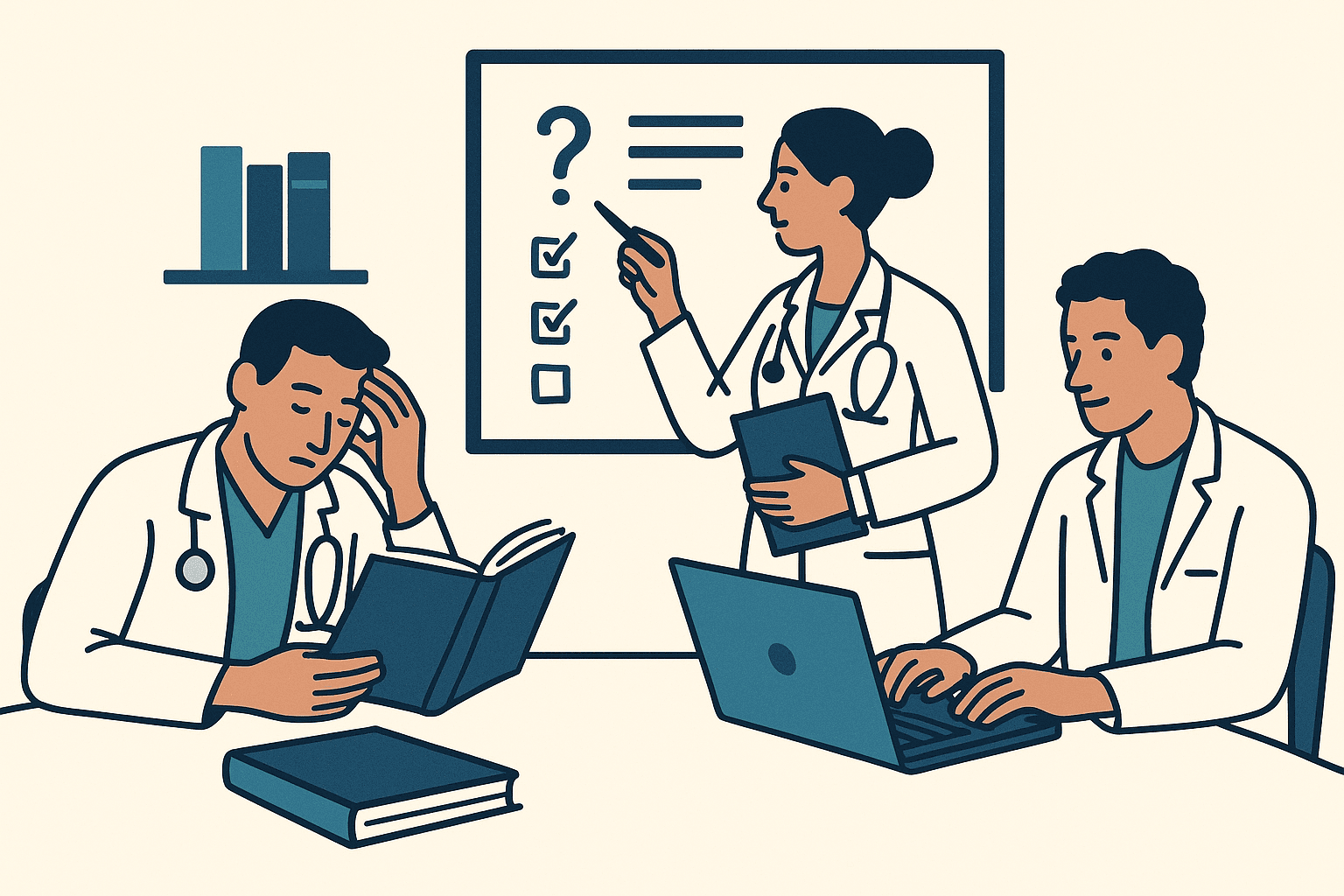
The traditional image of a doctor learning—surrounded by stacks of textbooks, highlighting passages late into the night—is not just outdated; it is increasingly dangerous. In 2025, the sheer volume of medical knowledge, which now doubles every 73 days (PMC), has rendered passive reading an impossible strategy. For UK clinicians facing high-stakes exams like the MRCGP AKT or MRCP, and for those simply trying to stay safe on the wards, the old methods are failing.
This article explores the cognitive science behind this shift. We examine why "cognitive load" is the new enemy, why passive consumption is a trap, and how a new generation of adaptive, question-first tools like iatroX are aligning with the reality of how doctors actually learn and reason.
Cognitive load vs clinical workload
The modern clinician operates in a state of continuous cognitive overload. You are managing complex patients, navigating clunky EHRs, and processing hundreds of data points every hour. When you add learning to this mix, the "cognitive load theory" becomes critical.
- Intrinsic load: The inherent difficulty of the material (e.g., the Krebs cycle).
- Extraneous load: The effort required to find and process the information (e.g., searching three different PDFs to find a guideline).
- Germane load: The effort dedicated to actually learning and building schemas.
Old revision methods—reading long chapters or watching hour-length videos—add massive extraneous load. They force you to filter information that isn't relevant right now. Modern tools must be designed to reduce extraneous load (by providing instant, cited answers) so you can focus your limited mental energy on the germane load of learning.
Why passive reading no longer scales for clinicians
The evidence is definitive: passive consumption is the least effective way to learn. Re-reading a textbook or guideline gives you a "fluency illusion"—you recognise the text, so you think you know it. But when you are faced with a clinical scenario, that knowledge is often inaccessible.
- The alternative: Active retrieval. Testing yourself forces your brain to reconstruct the neural pathway to that information. This is why "question-first" learning is so powerful. It mimics the clinical reality of being presented with a problem and having to find a solution.
The gap between guideline knowledge and exam performance
Many trainees know the guidelines but fail the exam. Why? Because exams like the AKT and SCA don't test your ability to recite a guideline; they test your ability to apply it to a nuanced vignette.
- The "application gap": Reading a NICE CKS page on hypertension gives you the facts. But it doesn't teach you how to manage a 55-year-old Afro-Caribbean patient who is intolerant to CCBs.
- The fix: You need tools that bridge this gap. An AI-powered tool like iatroX allows you to "brainstorm" these specific scenarios, exploring the "what if?" questions that static guidelines can't answer, and then verifying the logic against the primary source.
The rise of adaptive, question-first learning
The solution to the information deluge is adaptivity. Static study plans are dead. If you already know cardiology, spending a week revising it is a waste of your most precious resource: time.
- Adaptive engines: Platforms like the iatroX Quiz use algorithms to diagnose your weak areas in real-time. They serve you questions on the topics you are struggling with, not the ones you enjoy.
- Spaced repetition: By automating the scheduling of your reviews, these tools ensure that you revisit information right at the point you are about to forget it—the most efficient moment for memory consolidation.
How modern tools align learning with clinical reasoning
The best new tools don't just help you pass exams; they make you a better doctor. They do this by aligning the learning process with clinical reasoning.
- From "fact" to "feature": Instead of learning a list of symptoms, you learn to recognise "illness scripts."
- From "answer" to "provenance": Modern AI tools like iatroX and OpenEvidence don't just give you an answer; they show you the source (the guideline). This reinforces the habit of evidence-based verification, which is the cornerstone of safe practice.
What doctors should demand from digital learning platforms
In 2025, you should not settle for a digital textbook. You should demand a platform that:
- Respects your time: Uses adaptive algorithms to cut out what you already know.
- Reduces cognitive load: Provides instant, cited answers to clinical questions without "tab-hopping."
- Aligns with your reality: Maps content directly to UK curricula (UKMLA, AKT, MRCP) and national guidance (NICE, BNF).
- Proves its value: Tracks your performance and CPD automatically.
This is the philosophy behind iatroX. We built it not just to be another app, but to be the cognitive partner that the modern, overloaded clinician needs to survive and thrive.